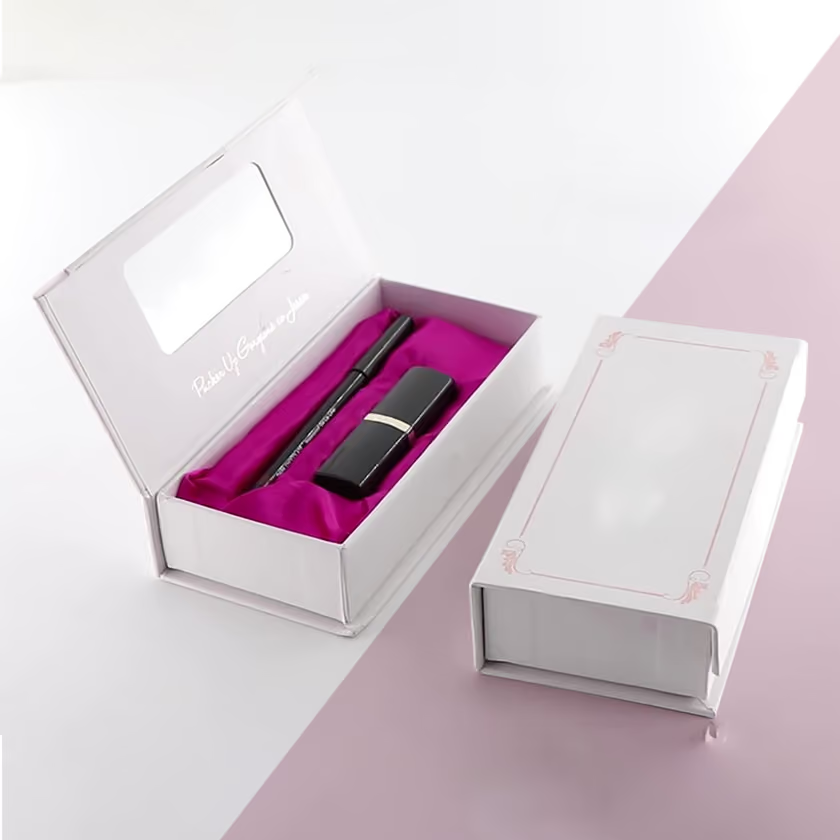


Lipstick packaging
Rigid Lipstick Boxes
Wrapped greyboard boxes that hold their shape permanently, built for gift sets, limited editions and lipstick at a luxury price point.
- Greyboard core wrapped in printed or specialty paper
- Magnetic closure, drawer and sleeve, or lift-off lid construction
- Fitted trays that hold a single bullet or a full shade set
Price starts from $0.30 per piece for large-volume orders. Final pricing depends on size, material, printing, and quantity.
The starting figure applies to qualifying large-volume custom orders. It is not a fixed price for every quantity, and your written quote will state the actual unit price for your job.
Ask for a written price
Four fields. We reply with a written price for your quantity, or with the questions we need answered first.
When a rigid box is the right call
A rigid box is made from thick greyboard cut to size, assembled into a permanent shape, and wrapped in printed or specialty paper. Unlike a folding carton it does not ship flat and does not fold, which makes it more expensive to produce and to freight. What you get in return is a box that keeps its exact shape indefinitely, opens with weight and resistance, and gets kept rather than discarded.
For everyday lipstick sold at a mid-market price, that cost is difficult to justify, and a well-finished folding carton does the job. Rigid construction earns its place on limited editions, holiday gift sets, influencer and press kits, and any lipstick priced high enough that the unboxing forms part of what the customer is buying.
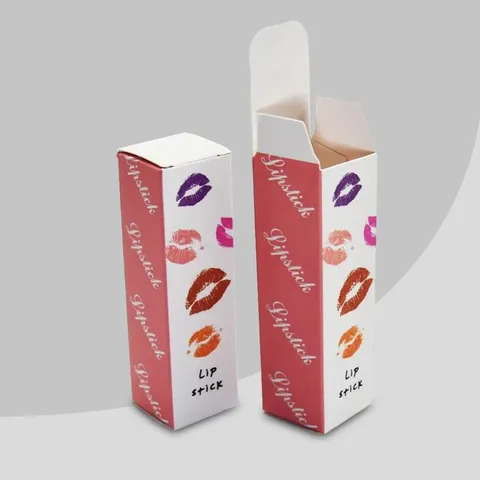
If the run is large and the price point is mainstream, the same visual ambition can often be reached with a soft-touch laminated folding carton at a fraction of the unit cost. Our printed folding cartons for lipstick cover that route.
Rigid box constructions
Each construction produces a different opening action, and the opening action is most of what the customer remembers.
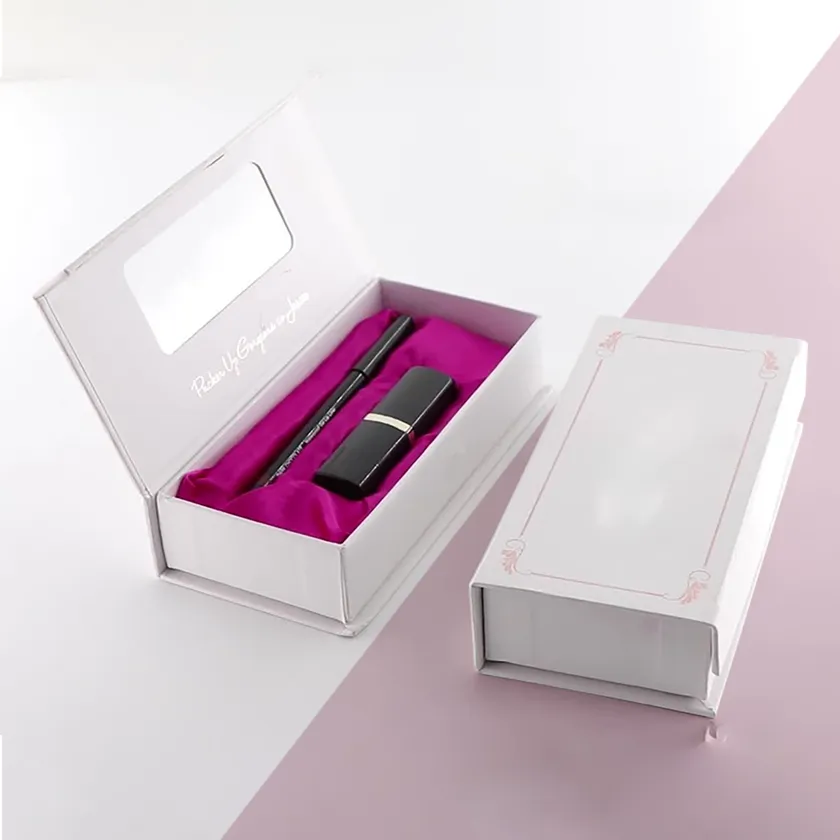
Magnetic closure book box
A hinged lid with concealed magnets that closes with an audible click. The most recognisable premium cosmetic format.
Drawer and sleeve
An inner tray that slides out of an outer shell, often with a ribbon pull. Reads as considered and protects the contents on all sides.
Two-piece lid and base
A separate lid lifting off a base, the classic shoulder-box format. Simple, sturdy and the least expensive rigid option.
Shoulder neck box
A lid and base separated by a visible collar, allowing a contrasting colour or material in the gap.
Hinged flip-top
A lid hinged along the back edge without magnets, held by a tuck flap or a ribbon closure.
Book-style presentation case
Opens like a hardback, with a fitted tray inside. Used for press kits and full-shade collections.
Trays, inserts and how the lipstick presents
In a rigid box the insert does as much work as the outer shell. It holds the lipstick at the angle you choose, keeps it from moving in transit, and controls what the customer sees in the first second after the lid lifts.
The common options are a die-cut card platform, a foam pad wrapped in printed or coloured paper, a moulded pulp tray, an EVA or flocked plastic tray, and a satin or velvet-lined recess. Card and moulded pulp keep the pack closer to a single material stream. Flocked plastic and satin give the deepest luxury read but add materials that will not recycle with the board.
Multi-shade sets need a partitioned tray so cases cannot touch. Lacquered and foiled lipstick cases mark each other easily, and a set that arrives scratched undoes everything the box was meant to achieve.
Board, wraps and linings
A rigid box is a sandwich: a structural core, a decorative outer wrap and usually an inner lining. Each layer is specified separately.
- Greyboard core from 1.5 mm to 3 mm, selected against box size and the weight it carries
- Printed art paper wrap for full-colour designs and photographic artwork
- Uncoated and textured specialty papers, including laid, felt and linen-embossed finishes
- Coloured fine papers where a solid, deep colour matters more than printed detail
- Leatherette and paper-backed cloth wraps for the highest presentation level
- Inner linings in printed paper, coloured paper, satin, velvet or flocked material
Textured wraps take foil beautifully and printed halftones poorly, so specialty papers usually pair with foil or emboss rather than with photographic artwork. The behaviour of each surface is set out on the finishing and surface treatment page.
Decorating a wrapped surface
The wrap is printed flat and then applied to the assembled box, which means artwork has to allow for the turn-in at every edge and for the way the paper stretches slightly as it is wrapped. Elements placed exactly on a corner will not land exactly on the corner, so designs for rigid boxes tend to keep detail away from the edges.
Foil stamping and embossing are applied to the wrap after printing and before assembly, and both are extremely well suited to this format because the greyboard beneath gives a firm surface to press against. A deep emboss on a rigid box holds far more definition than the same emboss on a thin folding carton.
Screen printing is an option for a single heavy solid or a thick opaque white on a dark wrap, where offset ink alone would look thin. Spot UV, soft-touch lamination and matte varnish are all available on printed art paper wraps.
Sizing, wall thickness and shipping weight
Rigid boxes are quoted from internal dimensions, and the wall thickness is added outside them. A 2 mm greyboard wall plus wrap adds roughly 2.5 mm to each side, so an internal cavity of 40 mm becomes an external box of about 45 mm. That matters if the box has to fit an existing shipper or a retail fixture.
These boxes are noticeably heavier than folding cartons of the same size, which affects both your outbound shipping cost and your carbon footprint per unit. For an e-commerce brand shipping single units, the difference over thousands of orders is real. It is a legitimate reason to reserve rigid construction for gift and limited-edition lines.
They also ship to you assembled, so inbound freight is charged on volume. Ordering in fewer, larger consignments makes a material difference to delivered cost. Freight handling is covered on the shipping and delivery page.
Artwork for wrapped construction
We supply a flat wrap template showing the panel positions, the turn-in allowance at each edge and the corner relief cuts. Build to that template, in CMYK plus spot colours, at 300 dpi, with fonts outlined. Foil and emboss areas go on separate 100% black vector layers.
Keep type and logos at least 5 mm inside any edge or fold line. Wrapping tolerance on a rigid box is wider than die-cutting tolerance on a carton, and a logo placed tight to a corner will look off-centre on some units even when production is within specification.
For a lid and base construction, the lid and base are separate wraps and are printed separately, so any artwork intended to align across the join needs an explicit tolerance built in. Where alignment is critical, a band or a ribbon across the join is a more reliable design solution than trying to register two wraps precisely.
Quantity, hand assembly and price
Rigid boxes involve substantial hand work: wrapping, corner finishing, magnet setting and insert fitting are all partly manual. That changes the cost curve. Unlike folding cartons, where doubling the quantity cuts the unit price sharply, rigid box pricing flattens out sooner because labour scales with volume rather than being spread across it.
Price starts from $0.30 per piece for large-volume orders. Final pricing depends on size, material, printing, and quantity. Rigid construction sits well above that entry figure in practice, because the greyboard, the wrap, the assembly labour and the insert are all additional to a printed sheet. Treat the starting price as the floor for the simplest products on this site, not as an indication for this one.
Because setup is lower relative to unit cost, rigid boxes are viable at genuinely small quantities. A limited edition of 500 is a normal order here in a way it would not be for a foiled litho carton.
How a rigid box order runs
Define the contents
Lipstick case dimensions, how many pieces, whether a mirror, card or applicator is included, and how it should sit.
Construction and materials
We propose a construction, greyboard thickness, wrap material and insert type against your price point and quantity.
White sample
An unprinted assembled sample confirms proportions, fit, magnet strength and the opening action before artwork is committed.
Printed sample and approval
A production-standard sample in the final materials, with foil and emboss in place, for written sign-off.
Production and packing
Assembly, inspection and packing with protective separation, since assembled boxes mark each other in transit.
Quality control and end-of-life
Rigid boxes are inspected individually rather than sampled, because hand assembly produces unit-to-unit variation that machine die-cutting does not. The checks are corner sharpness, wrap alignment, lid-to-base fit, magnet closing force and insert seating. A lid that fits too tightly is as much a defect as one that fits too loosely.
On disposal: greyboard and a paper wrap are compatible with paper recycling once any magnets are removed, and the magnets are the main obstacle since they are steel or neodymium set into the board. Ribbon, satin lining, flocked trays and foam are all separate materials. If you want a rigid box that stays in one stream, specify a paper wrap without lamination, a card insert, and a construction that closes without magnets.
We will describe accurately what a given specification is made of rather than applying a general environmental claim to the format.
Rigid Lipstick Boxes specification
A summary of what can be specified on this product. Anything marked as quoted or made to order is confirmed in writing before production.
| Product type | Set-up rigid box for lipstick and lip colour sets |
|---|---|
| Constructions | Magnetic book box, drawer and sleeve, two-piece lid and base, shoulder neck, hinged flip-top, book style |
| Core material | Greyboard 1.5 mm to 3 mm, selected against size and contents weight |
| Wrap materials | Printed art paper, textured specialty paper, coloured fine paper, leatherette, paper-backed cloth |
| Linings | Printed paper, coloured paper, satin, velvet, flocked material |
| Inserts | Die-cut card platform, wrapped foam, moulded pulp, EVA, flocked plastic tray |
| Decoration | Offset print, hot foil stamping, emboss, deboss, screen print, spot UV, soft-touch lamination |
| Extras | Ribbon pulls, fitted mirrors, magnets, elastic retainers, printed inner cards |
| Sizing | Quoted from internal dimensions; wall and wrap add approximately 2.5 mm per side |
| Supply | Shipped assembled, not flat; inbound freight charged on volume |
| Small runs | Viable at low quantities because setup cost is low relative to unit cost |
| Starting unit price | Sitewide entry price is $0.30 per piece on qualifying large-volume orders; rigid construction is quoted above it |
| Ordering | Quote based; white sample recommended before artwork |
Rigid Lipstick Boxes: common questions
Answers to the questions we are asked most often about this product. If yours is not here, put it in the enquiry form and we will answer it directly.
How much more does a rigid box cost than a folding carton?
Enough that the two are not really substitutes. A rigid box adds greyboard, a separate wrap, hand assembly and usually an insert. The gap narrows at small quantities, where a folding carton is carrying plate and die charges across few units, and widens considerably at high volume.
Do rigid boxes ship flat?
No. They arrive assembled, which means inbound freight is charged on volume rather than weight and a pallet holds far fewer boxes than it would of flat cartons. Collapsible rigid constructions exist and reduce this, at some cost to the opening feel.
Which construction feels most premium?
A magnetic book box is the format most customers associate with luxury cosmetics, largely because of the closing action. A drawer and sleeve reads as more considered and reveals the product gradually. Both outperform a plain lift-off lid, which is the most economical of the three.
Can you fit a mirror inside the lid?
Yes. A mirror is set into a recess in the lid lining during assembly. Tell us the mirror size you want at quoting stage, because it changes the lid construction and the lining, and it is not something that can be added to a design later without a rebuild.
What is the minimum quantity for a rigid box?
Lower than you might expect. Because the setup cost is small relative to the unit cost, runs in the hundreds are practical. A limited edition of 500 is a normal order for this format, where the same quantity of foiled litho cartons would be dominated by plate charges.
Will my photographic artwork print well on a textured wrap?
Not as well as on smooth art paper. Texture breaks up halftone dots and softens fine detail. Textured stocks are at their strongest with foil, emboss and solid colour. If the design depends on a photograph, use a smooth coated wrap and add texture through an emboss instead.
How accurate is artwork alignment across a lid and base?
Less accurate than on a folding carton, because lid and base are wrapped separately by hand. Designs that need a continuous image across the join will show some variation. A deliberate band, ribbon or colour break at the join is the reliable way to handle it.
Can a rigid box hold a full shade collection?
Yes. A partitioned tray holds each case in its own recess so they cannot touch. That partition matters: lacquered and foiled lipstick cases scratch one another easily, and a collection that arrives marked defeats the purpose of the pack.
Are magnetic boxes recyclable?
The greyboard and paper wrap are compatible with paper recycling, but the magnets are steel or neodymium and have to come out first, which most consumers will not do. If recyclability is a priority, ask for a construction that closes with a tuck flap or a ribbon instead of magnets.
Why do you recommend a white sample first?
Because proportion, magnet strength, lid fit and the opening action are things you have to hold to judge. An unprinted assembled sample lets you correct all of that before artwork and foil dies are committed, which is much cheaper than finding a problem on a printed sample.
Can the inside of the box be printed?
Yes. The lining is a separate printed sheet, so it can carry a message, a shade chart, artwork or a thank-you note. It is one of the highest-impact and lowest-cost additions available on this format, since the customer sees it at the exact moment the lid opens.
How are assembled boxes protected in transit to me?
They are packed with separation between units, because assembled boxes with foil, soft-touch or coloured wraps mark each other under pressure. Individual polybags or interleaving sheets are standard, and the case count is set so the bottom layer is not crushed.
Often specified together

Get a written price for rigid lipstick boxes
Send your dimensions, quantity and artwork status. You will get a written quote with the price at your quantity and at the next volume break, plus anything we need clarified.
Price starts from $0.30 per piece for large-volume orders. Final pricing depends on size, material, printing, and quantity.