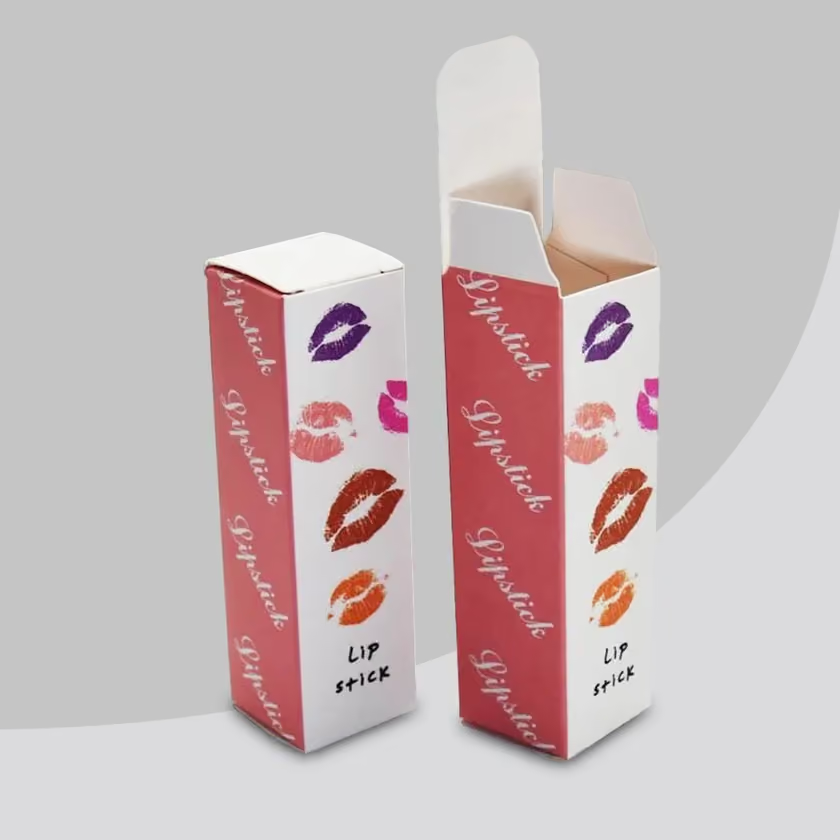


Lipstick packaging
Custom Lipstick Boxes
Folding cartons sized to the exact bullet case you fill, from single-shade tuck end boxes to full range presentation packs.
- Built around your specific bullet case, cap included
- Single, duo and multi-shade layouts with fitted inserts
- Foil, soft-touch and spot UV finishing for premium ranges
Price starts from $0.30 per piece for large-volume orders. Final pricing depends on size, material, printing, and quantity.
The starting figure applies to qualifying large-volume custom orders. It is not a fixed price for every quantity, and your written quote will state the actual unit price for your job.
Ask for a written price
Four fields. We reply with a written price for your quantity, or with the questions we need answered first.
What a lipstick carton has to accommodate
Lipstick cases vary far more than lip balm tubes do. A slim metal bullet, a weighted magnetic case and a chunky square resin barrel might all hold the same 3.5 g of product and need three completely different cartons. There is no standard lipstick box size, and quoting from a generic one is how brands end up with cases that rattle or boxes that split.
The measurement that matters is the case at its widest point, with the cap fitted, plus its total height. Magnetic cases sometimes sit slightly proud at the join and that extra fraction of a millimetre is enough to bind a tight carton. Sending a physical sample is the most dependable route.
Once the dimensions are fixed, the carton style is mostly a merchandising decision. A straight tuck end suits shelf display and boxed e-commerce. A hanging version works on peg fixtures, and lipstick cartons cut with a peg hook tab use the same board with a die-cut slot added.
Formats these cartons cover
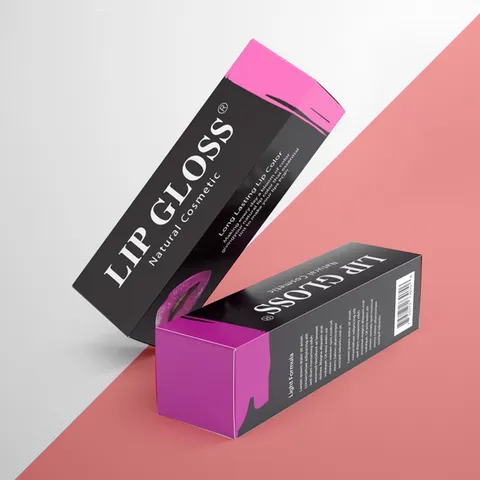
Single bullet cartons
The standard slim rectangular box, usually between 0.9 and 1.2 inches square and 3 to 3.5 inches tall depending on the case.
Duo and trio packs
Two or three shades side by side with a partition insert, sold as a gift or a shade set.
Liquid lipstick cartons
Taller and narrower to suit a doe-foot applicator wand, with more headroom above the neck of the bottle.
Lip kit and multi-item boxes
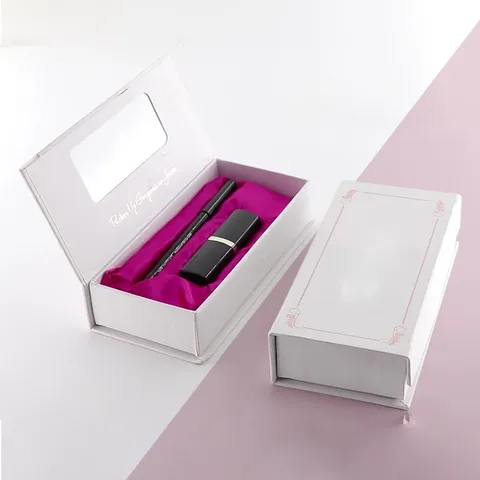
A lipstick with a liner, gloss or brush, held in a die-cut platform so the components do not shift.
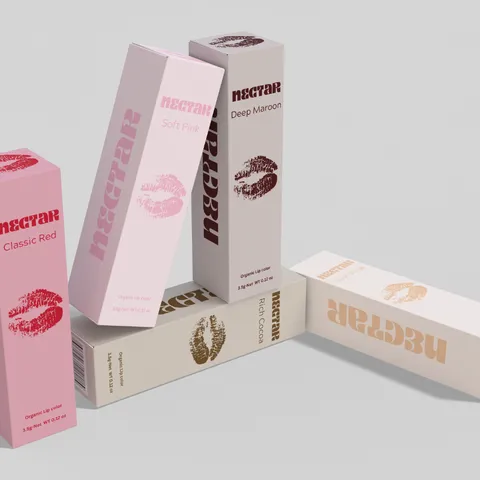
Shade range collections
One die line, one board, one finish, with only the printed panel changing per shade. The most economical way to run a full range.
Refill cartons
Lighter secondary packaging for refill bullets sold without the outer case, where the pack has to protect but not present.
Inserts, protection and presentation
A lipstick case is heavier than most cosmetic primaries of its size, particularly the metal-weighted ones. Dropped inside a loose carton it will move under its own inertia, and repeated movement in transit marks both the case and the inside of the box.
A folded paperboard collar or a die-cut platform holds the case at the base so it cannot slide. For duos and trios, a partition insert stops the cases knocking together, which matters more than it sounds when the cases have a lacquered or foiled finish that scratches.
Where the opening moment carries the brand, a moulded pulp tray or a foam-backed platform seats the lipstick at an angle so it presents itself as the lid lifts. That level of build usually belongs with a rigid lipstick box with a magnetic lid rather than a folding carton, but both are quoted from the same enquiry.
Board and stock options
Lipstick sits at a higher price point than most lip care, and the board is a meaningful part of how the pack is judged before it is opened.
- SBS folding boxboard, 18pt to 24pt, the standard for full-colour cosmetic cartons
- Heavier 24pt to 28pt board where the pack must feel substantial in the hand
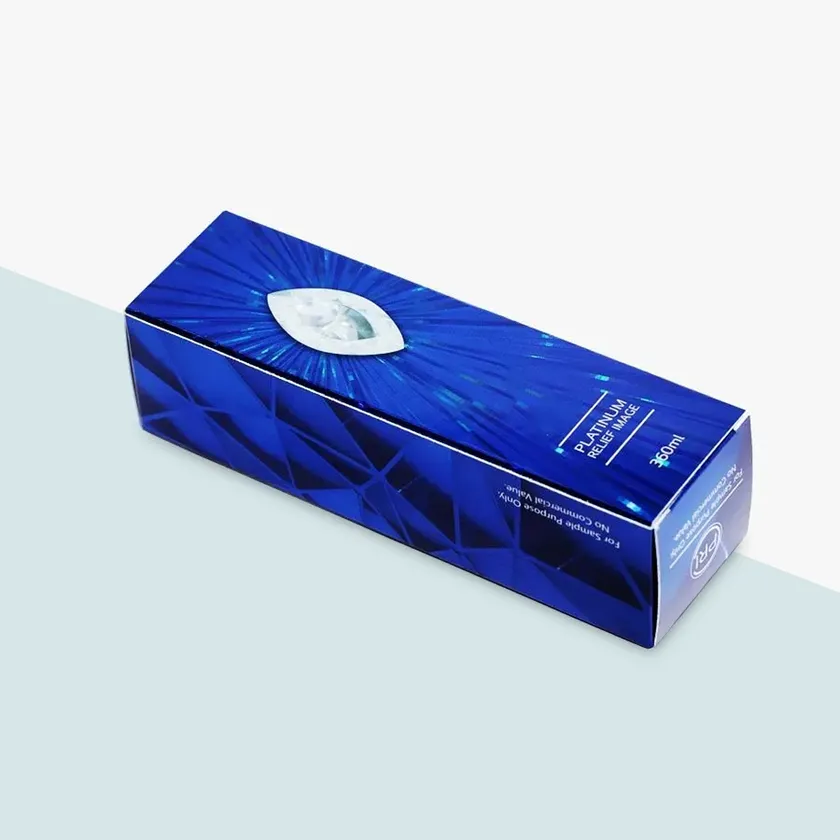
- Metallised board with a mirror silver or gold face beneath the print
- Black-through board, coloured in the pulp so cut edges stay black
- Textured and laid papers laminated to board for a tactile premium surface
- Recycled greyback board where recycled content matters more than a white reverse
Black-through board is worth knowing about: on a standard white board with a printed black exterior, every cut edge shows a thin white line, which is very visible on a dark carton.
Printing a shade range accurately
The specific challenge with lipstick packaging is that the carton often shows a swatch of the shade inside, and shoppers compare that swatch against the product. A four-colour process build drifts between print runs; a spot Pantone does not. Brands that run a shade range across repeat orders usually specify each swatch as a spot colour and accept the extra ink station.
Offset litho holds fine detail and delivers the lowest unit cost once quantities pass a couple of thousand. Digital printing makes sense for a launch range where you want twelve shades at modest quantities each, since there are no plate charges per design. Both are available, and the crossover point moves with the number of shades.
Colour on a metallised board behaves differently again, because the reflective base shows through translucent inks. Ask for a proof on the actual stock before signing off if the artwork uses metallic effects.
Finishing for a premium shelf position
Soft-touch lamination
The finish most associated with premium colour cosmetics. Velvety, slightly warm, and it makes a mid-priced pack feel considerably more expensive.
Hot foil stamping
Gold, silver, rose gold, copper and coloured foils, pressed with heat and pressure. Reads as genuinely metallic in a way printed metallic ink does not.
Spot UV over matte
Gloss varnish on selected artwork against a matte background. High contrast, low cost relative to foil.
Embossing
Raised detail in the board, often combined with foil so the stamped area also sits proud of the surface.
Metallic and pearlescent inks
A shimmer across a large area, which foil cannot economically cover. Subtler than foil and cheaper at scale.
Matte lamination
A calm, non-reflective base that lets foil and spot UV do the work. Standard under most premium finishing combinations.
Artwork, shade naming and regulated copy
Build files to the supplied die line, in CMYK plus any spot colours, at 300 dpi, with 3 mm bleed and fonts outlined. Keep live copy 4 mm inside the trim. Foil, emboss and spot UV each need their own 100% black vector layer, named clearly, so the finishing plates can be made from them.
A lipstick carton usually carries more copy than a lip balm one: shade name, shade number, finish descriptor, net weight, ingredient declaration and often a batch panel. Plan the panel allocation before designing rather than fitting the legal copy into what is left over.
Where a range shares one die line, keep every fixed element in exactly the same position across all shades and change only the swatch and the shade name. It looks intentional on shelf and it makes proofing twelve variants a manageable task instead of twelve separate reviews. The file setup detail sits on the artwork specification page.
Quantity, shade counts and unit price
Lipstick ranges create an awkward quantity problem: you may want 20,000 cartons in total but only 1,600 of each shade. Digital printing solves it at moderate volumes. At higher volumes, ganging several shades onto one litho sheet keeps the plate cost shared while retaining offset quality.
Price starts from $0.30 per piece for large-volume orders. Final pricing depends on size, material, printing, and quantity. A plain single-colour carton at high volume approaches that figure; a soft-touch laminated carton with foil, an insert and twelve shade variants sits well above it.
Tell us the shade count and the per-shade quantity in the enquiry, not just the total. It changes which process we quote and can materially change the price.
From brief to delivered cartons
Send a case sample or dimensions
Width at the widest point with the cap on, plus total height. A physical sample removes all doubt.
Specification and quote
Board, print process, finishing and insert are proposed against your quantity and shade count, with a written price.
Die line and structural sample
A plain cut-and-creased sample confirms the case fits and the insert holds before any printing happens.
Colour proof per shade
Every shade variant is proofed. Written approval on all of them releases the run.
Production and delivery
Print, finish, die-cut, glue, insert supply and case packing, then dispatch with tracking.
Quality control, materials and turnaround
Colour consistency across a shade range is the check that matters most here. Each variant is measured against its approved proof, and where shades are close to each other they are compared side by side rather than individually, because a shopper will see them next to one another on the shelf.
Paperboard cartons are widely accepted in US paper recycling. Soft-touch and gloss laminates are plastic films and complicate that, so where end-of-life matters, a varnish finish on an uncoated or lightly coated board keeps the pack in one stream. Metallised board is not paper-recyclable and should not be described as though it were.
Production time varies with the finishing. Foil, emboss and soft-touch each add a pass. We confirm a schedule in writing with the quote, and current bands are published on the lead time page.
Custom Lipstick Boxes specification
A summary of what can be specified on this product. Anything marked as quoted or made to order is confirmed in writing before production.
| Product type | Custom printed folding carton for lipstick and liquid lipstick |
|---|---|
| Sizing | Built to your bullet case dimensions or to a supplied sample |
| Typical single-bullet footprint | Approximately 0.9–1.2 in square, 3–3.5 in tall |
| Materials | SBS 18–28pt, metallised board, black-through board, textured laminated papers, recycled board |
| Printing | Offset litho and digital; CMYK plus spot Pantone for shade swatches |
| Finishes | Soft-touch, matte and gloss lamination, hot foil, spot UV, emboss, deboss, pearlescent ink |
| Structural styles | Straight tuck end, reverse tuck end, seal end, auto-bottom, sleeve and tray |
| Inserts | Paperboard collar, die-cut platform, partition for duo and trio packs, moulded pulp |
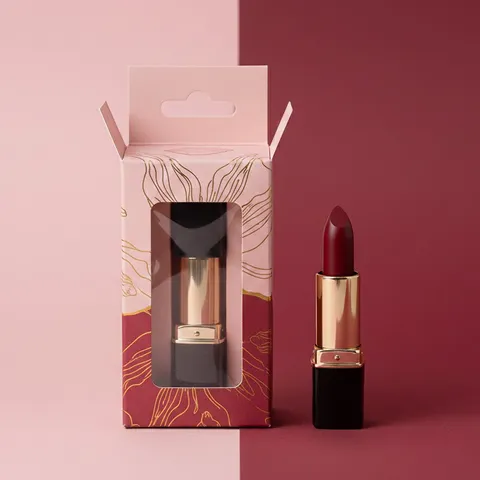
| Windows | Die-cut with optional clear film patch |
| Range support | One die line across multiple shades; per-shade artwork variants |
| Artwork format | PDF, AI, EPS at 300 dpi, 3 mm bleed, separate vector layers for foil and emboss |
| Starting unit price | From $0.30 per piece on qualifying large-volume orders |
| Ordering | Quote based; per-shade quantities affect the print process selected |
Custom Lipstick Boxes: common questions
Answers to the questions we are asked most often about this product. If yours is not here, put it in the enquiry form and we will answer it directly.
Is there a standard lipstick box size?
No. Cases differ enough that a standard size would fit almost nothing properly. A common single-bullet carton lands between 0.9 and 1.2 inches square and 3 to 3.5 inches tall, but that is a range, not a specification. Measure your case at its widest point with the cap on.
Why do you want a physical sample of my lipstick case?
Because supplier drawings frequently omit real-world tolerances, especially on magnetic cases where the cap can sit slightly proud at the join. A carton built to a drawing that is a fraction under-size will bind on the line. A sample removes that risk entirely.
Can I run twelve shades without paying for twelve setups?
Yes. All twelve share one die line, one board and one finish, and only the printed panel changes. On digital there is no per-design plate charge at all. On offset the shades can be ganged onto shared plates. Tell us the shade count and per-shade quantity so we quote the right route.
How do I keep the shade swatch on the box matching the lipstick?
Specify the swatch as a spot Pantone rather than a CMYK build. Process colour drifts between runs within normal tolerance, which is enough to make a nude look different from the one a customer bought last month. A spot colour reproduces the same way every time.
What is black-through board and do I need it?
It is board coloured black throughout rather than printed black on a white base. You need it if your carton is dark, because on standard board every die-cut and creased edge shows a thin white line. On a black soft-touch pack that line is the first thing people notice.
Should I add an insert to a single lipstick box?
Usually yes for anything above an entry price point. A lipstick case is dense and will slide in a loose carton, marking both the case finish and the box interior in transit. A simple folded paperboard collar costs little and fixes it.
Can you do foil on a dark matte carton?
Yes, and it is one of the most effective combinations available. Matte lamination gives the foil something to contrast against. Keep the foil areas reasonably compact, since large solid foil panels are harder to lay down evenly and show any imperfection in the board underneath.
What is the difference between metallic ink and foil?
Foil is real metal leaf pressed into the board, so it genuinely reflects. Metallic ink is a printed ink containing metallic particles, which shimmers but does not mirror. Foil is more striking on small areas; metallic ink is far more economical over large ones.
Do you supply the insert as well as the box?
Yes, both are quoted and produced together. Supplying them from one source means the insert is made to the same die line and tested in the actual carton, rather than being sourced separately and found to be a millimetre out during packing.
How much copy will actually fit on a slim lipstick carton?
Less than most brands expect. Between shade name, net weight, ingredient declaration, responsible party details and a barcode, the panels fill quickly. Allocate the panels before designing. If the ingredient list is long, a small folded leaflet inside the carton is a common answer.
Are laminated lipstick cartons recyclable?
Paperboard is widely recycled in the United States, but a plastic laminate film complicates that and metallised board is not paper-recyclable at all. If end-of-life is a priority, a varnish on uncoated or lightly coated board keeps the pack in a single stream. We will tell you exactly what is on your specification.
Can I reorder a single shade from a range later?
Yes. Once the die and the proofs are approved and held, any individual shade can be reordered on its own. The economics change, because a single-shade reorder loses the sharing benefit, but there is no new setup to pay for.
Often specified together
Get a written price for custom lipstick boxes
Send your dimensions, quantity and artwork status. You will get a written quote with the price at your quantity and at the next volume break, plus anything we need clarified.
Price starts from $0.30 per piece for large-volume orders. Final pricing depends on size, material, printing, and quantity.