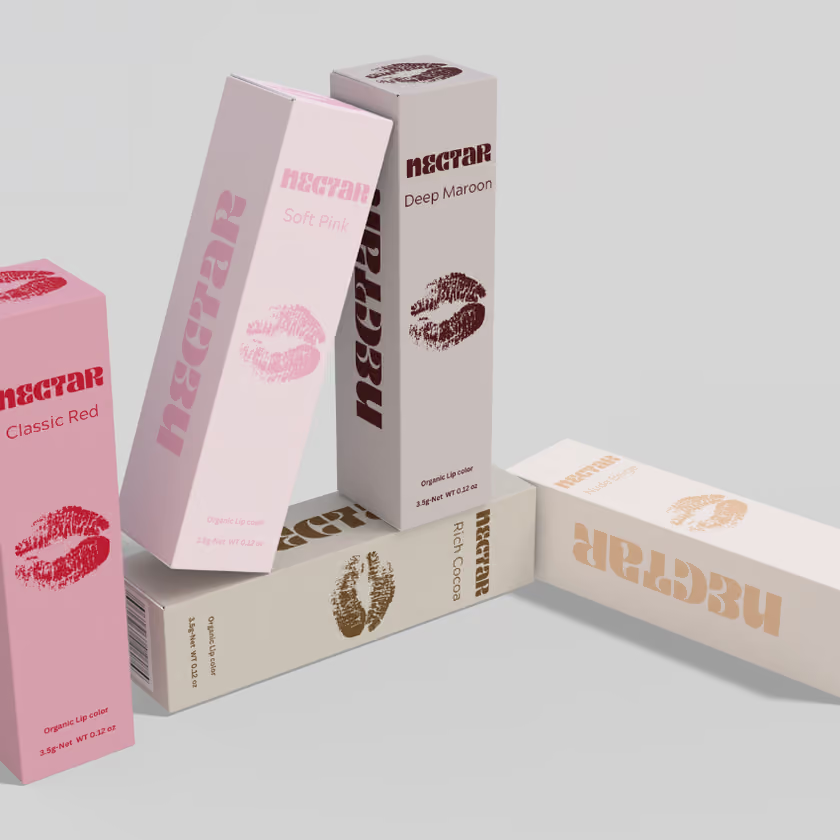


Lip Care packaging
Custom Lip Care Packaging in Bulk
Bulk programmes for brands packaging an entire lip line at once, with one board, one finish and one production schedule across every product.
- One material and finishing specification across an entire range
- Shared proofing, scheduled call-offs and consolidated freight
- Suits private label, contract fillers and multi-SKU launches
Price starts from $0.30 per piece for large-volume orders. Final pricing depends on size, material, printing, and quantity.
The starting figure applies to qualifying large-volume custom orders. It is not a fixed price for every quantity, and your written quote will state the actual unit price for your job.
Price this specification
Four fields. We reply with a written price for your quantity, or with the questions we need answered first.
Packaging a range rather than a product
Most enquiries we receive are for one item. This page is for the other kind: a brand launching or relaunching a whole lip line, a private label operation packaging under several names, or a contract filler buying cartons on behalf of multiple clients.
The economics of that work are different. When you are ordering balm cartons, gloss cartons, lipstick cartons and a gift set together, the sensible approach is to fix the board, the finish and the print process once and apply them across everything. Doing so consolidates the material buy, shares the proofing effort, and lets the whole programme run on one production schedule instead of five.
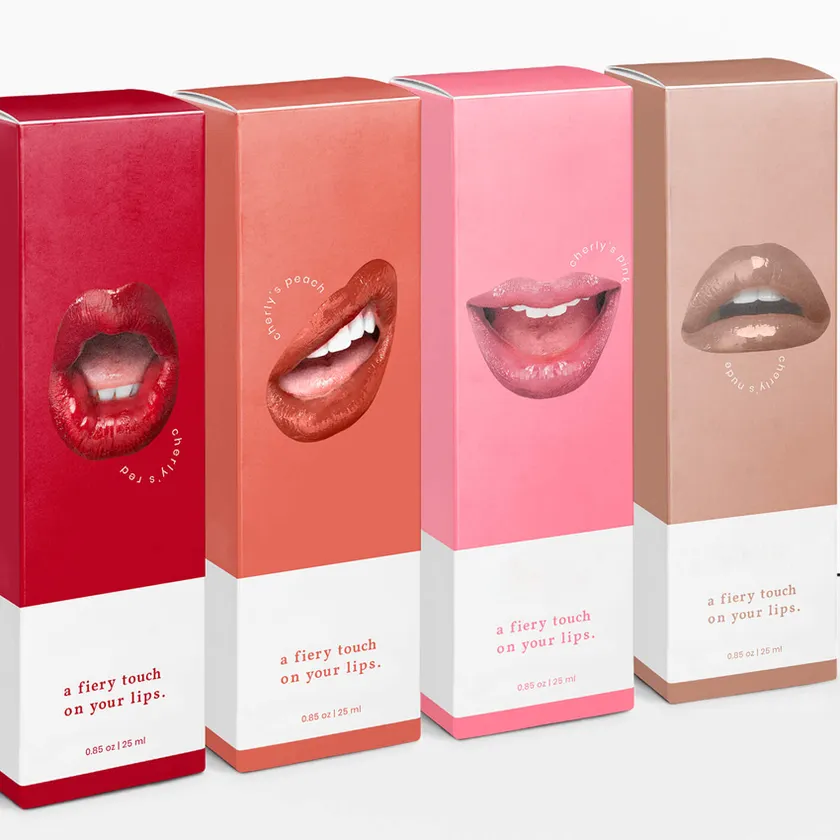
It also produces a range that looks like a range. Products specified separately over eighteen months drift apart in board colour, laminate sheen and print density, and shoppers notice that when the items sit next to one another.
What a bulk programme usually covers
A single programme can include any combination of the formats we produce. These are the components most ranges need.
Primary cartons per SKU
Individual boxes for each product in the line, sharing board, finish and print process while differing in die line and artwork.
Applied labels
Wrap labels, cap seals and tamper bands for tubes, tins and jars, printed to the same colour standard as the cartons.
Gift and starter sets
A tray or rigid box holding a selection from the range, quoted alongside the individual cartons.
Inserts and platforms
Collars, partitions and die-cut trays specified once per format rather than reinvented per product.
Retail-ready shippers
Printed counter display units and case-ready trays for products going into fixture programmes.
Mailer and subscription packaging
Printed corrugated mailers, tissue and insert cards for the direct-to-consumer side of the same range.
Standardising the specification across SKUs
The single most useful decision in a range programme is to reduce the number of variables. One board grade in two weights. One laminate. One print process. One ink set with a fixed number of spot colours. Everything else is die lines and artwork.
That does three things. It lets the material be bought in one quantity rather than several, which is where most of the saving comes from. It makes colour consistent across products, because they are printed on the same stock with the same inks. And it collapses proofing from a series of separate reviews into one standard plus a set of variants.
Where products genuinely need different treatment, keep the exceptions deliberate and few. A gift set in a rigid box is a reasonable exception; five different laminates across five products is not. Our custom packaging overview sets out how the pieces fit together across formats.
Private label and contract filling
Private label programmes add a layer: the same physical carton may be printed for several different brands. That works well when the structural specification is fixed and only the artwork changes, and it is one of the most economical ways to run this kind of business, because the die line and the structural sample are amortised across every brand using the format.
For contract fillers, the constraints usually come from the line rather than the brand. Case counts, pallet patterns, carton feed orientation and whether the carton needs to be glued closed on an automatic sealer all matter more than the artwork does. Send us the line specification and we will build to it.
We can hold approved die lines and colour standards against a programme so any brand within it can be reordered without repeating setup. Tell us at quoting stage how many brands and how many SKUs the programme covers.
Materials for a whole-range specification
A range programme normally settles on two board weights, one for slim single-unit cartons and one for heavier multi-unit packs.
- SBS coated white board 16pt to 18pt for slim single-product cartons
- SBS coated white board 22pt to 24pt for multipacks, sets and anything holding weight
- Kraft board in matching weights where the whole range positions as natural
- Black-through board where the range is predominantly dark
- E-flute corrugated for display units, shippers and direct mailers
- Greyboard with a printed wrap for the rigid gift item in a range
Committing to one board family across a programme is what makes a range look coherent on shelf. The characteristics of each grade are set out on the board and stock reference.
Printing a multi-SKU programme
Offset litho is normally the right process for a bulk programme, because the quantities justify plate costs and multiple SKUs can be ganged onto shared sheets. Ganging is where a substantial part of the saving comes from on a range: several die lines printed on one sheet share the make-ready.
Digital printing still has a place, usually for the lowest-volume SKUs in the range or for a test product ahead of a full launch. Running most of the range litho and one or two items digitally is a normal arrangement, though colour has to be managed carefully across the two processes if the products sit together on shelf.
Fix the spot colours at the start. A programme with two brand spot colours plus process ink is manageable; one where each SKU introduces its own spot colour loses the ganging benefit almost entirely.
Managing artwork across many SKUs
The workable method is a master template per format, with fixed elements locked in position and a defined set of variable zones. Brand mark, legal panel position, barcode area and net weight placement stay identical; product name, swatch and ingredient copy vary. That way twelve SKUs review as one standard plus twelve checks rather than twelve independent reviews.
Version control matters more than it does on a single product. Every file needs the SKU code, the die line reference and a revision number in the filename, and someone on your side needs to own the master list. The most common cause of a wrong print in a bulk programme is an outdated file being approved, not a production error.
We supply die lines with the variable zones marked, and hold approved artwork against each SKU. File requirements are the same as for individual products and are set out on the artwork guidelines page.
Quantity, call-offs and unit price
Bulk programmes are quoted on total programme volume rather than per SKU, which is the point of running them this way. Twelve SKUs at 3,000 each is priced as a 36,000-unit programme, not as twelve small orders, because the material, the make-ready and the finishing passes are shared.
Price starts from $0.30 per piece for large-volume orders. Final pricing depends on size, material, printing, and quantity. Bulk lip care programmes are where that entry figure is genuinely reachable, because the volume, the shared setup and a standardised specification all point the same way. A programme with many exceptions and small per-SKU quantities will not reach it.
Scheduled call-offs are available: the full quantity is produced in one run and released against a delivery schedule, which holds the volume price while managing your warehousing. Storage terms are agreed per programme.
How a programme is set up
Send the SKU list
Every product, its container dimensions, the quantity per SKU and the launch date. A spreadsheet is ideal.
Specification workshop
We propose a standard board family, finish and print process, and flag which SKUs need to be exceptions and why.
Programme quote
Priced on total volume with a per-SKU breakdown, plus alternatives at different total quantities.
Master templates and samples
Die lines and structural samples per format, with variable zones marked on the artwork templates.
Production and call-off
One production run across the programme, then delivery in full or released against an agreed schedule.
Quality control across a range, and lead time
The critical check on a programme is cross-SKU consistency rather than individual accuracy. Products are compared against each other as well as against their proofs, because a shopper sees the range side by side. Board shade, laminate sheen and the density of any shared brand colour are all checked between SKUs, and that comparison is done on finished cartons rather than on press sheets.
Each SKU also gets the standard dimensional, glue and fold checks. On a programme with several die lines running through one production window, the die records are checked against the SKU list before the run rather than during it.
Lead time on a programme is longer than for a single carton, because there is more artwork to approve and more tooling to make, but it is much shorter than running the same SKUs sequentially. We publish the bands we work to on the lead time page and confirm a programme schedule in writing.
Custom Lip Care Packaging specification
A summary of what can be specified on this product. Anything marked as quoted or made to order is confirmed in writing before production.
| Product type | Bulk and private label packaging programme across a lip care range |
|---|---|
| Scope | Primary cartons, labels, gift sets, inserts, display units, mailers |
| Pricing basis | Quoted on total programme volume with a per-SKU breakdown |
| Board family | Typically two weights of one grade across the range, plus corrugated for shippers |
| Printing | Offset litho with SKUs ganged on shared sheets; digital for lowest-volume items |
| Colour control | Fixed spot colour set across the programme, checked between SKUs |
| Artwork method | Master template per format with locked fixed elements and defined variable zones |
| Tooling | Die lines and colour standards held against the programme for reorders |
| Call-off | Produce in one run, release against an agreed delivery schedule |
| Private label | One structural specification printed for multiple brands |
| Contract filling | Built to your line specification including case counts and pallet patterns |
| Starting unit price | From $0.30 per piece on qualifying large-volume orders |
| Ordering | Quote based; send a full SKU list with quantities and launch dates |
Custom Lip Care Packaging: common questions
Answers to the questions we are asked most often about this product. If yours is not here, put it in the enquiry form and we will answer it directly.
How many SKUs does a bulk programme need to make sense?
There is no fixed threshold, but the savings become obvious from about four or five SKUs upward, because that is where shared material buying, ganged printing and consolidated proofing start to outweigh the effort of standardising. Below that, quoting products individually is usually simpler.
Do all the products have to use the same board?
Not strictly, but the more they do, the better the pricing and the more coherent the range looks. Most programmes settle on one grade in two weights, with deliberate exceptions where a product genuinely needs something else, such as a rigid gift box.
Can you price a programme rather than each item?
Yes, and that is how it should be quoted. Twelve SKUs at 3,000 each is a 36,000-unit programme, not twelve small orders. You get a total programme price plus a per-SKU breakdown so you can see how each item contributes.
What is ganging and why does it save money?
Ganging means printing several different die lines together on one press sheet, so they share the plates, the make-ready and the press time. On a multi-SKU range it is one of the largest single savings available, and it works most efficiently when every SKU uses the same board and the same ink set.
Can I produce everything now and take delivery over time?
Yes, through a scheduled call-off. The full quantity runs in one production window, holding the volume price, and stock is released against an agreed delivery schedule. Storage terms are set per programme, so raise it at quoting stage rather than afterwards.
How do you handle private label where several brands share a carton?
The structural specification stays fixed and only the artwork changes, so the die line and the structural sample are amortised across every brand using that format. Approved die lines and colour standards are held against the programme so any brand can be reordered without new setup.
What do you need from a contract filler?
The line specification more than the brand brief: case counts, pallet patterns, carton feed orientation, and whether cartons need to be glued closed on an automatic sealer. Those constraints shape the structural design far more than the artwork does.
How do you keep colour consistent across twelve products?
By fixing the board and the ink set at the start, printing on one process wherever possible, specifying shared brand colours as spot Pantones rather than process builds, and checking finished cartons against each other as well as against their individual proofs.
What goes wrong most often on multi-SKU programmes?
Outdated artwork being approved, not production errors. With twelve files in revision, the wrong version reaching print is the common failure. Every file needs the SKU code, die line reference and revision number in its filename, and one person on your side has to own the master list.
Can I add a SKU to the programme after it starts?
Yes, but the later it comes the less it benefits from the shared setup. A SKU added after the main run is priced closer to a standalone order because it misses the ganging and the shared make-ready. If a product is likely to join, include it in the initial quote even provisionally.
Does a bulk programme take longer than a single order?
Longer than one carton, because there is more artwork to approve and more tooling to make, but much shorter than running the same SKUs one after another. The gating factor is usually artwork approval on your side rather than production on ours.
Can you supply retail display units alongside the range?
Yes. Printed counter display units and case-ready trays are quoted within the same programme, in E-flute corrugated, using the same artwork family. Producing them together is the only reliable way to keep the display colour matching the cartons sitting in it.
Commonly ordered alongside
Get a written price for custom lip care packaging
Send your dimensions, quantity and artwork status. You will get a written quote with the price at your quantity and at the next volume break, plus anything we need clarified.
Price starts from $0.30 per piece for large-volume orders. Final pricing depends on size, material, printing, and quantity.