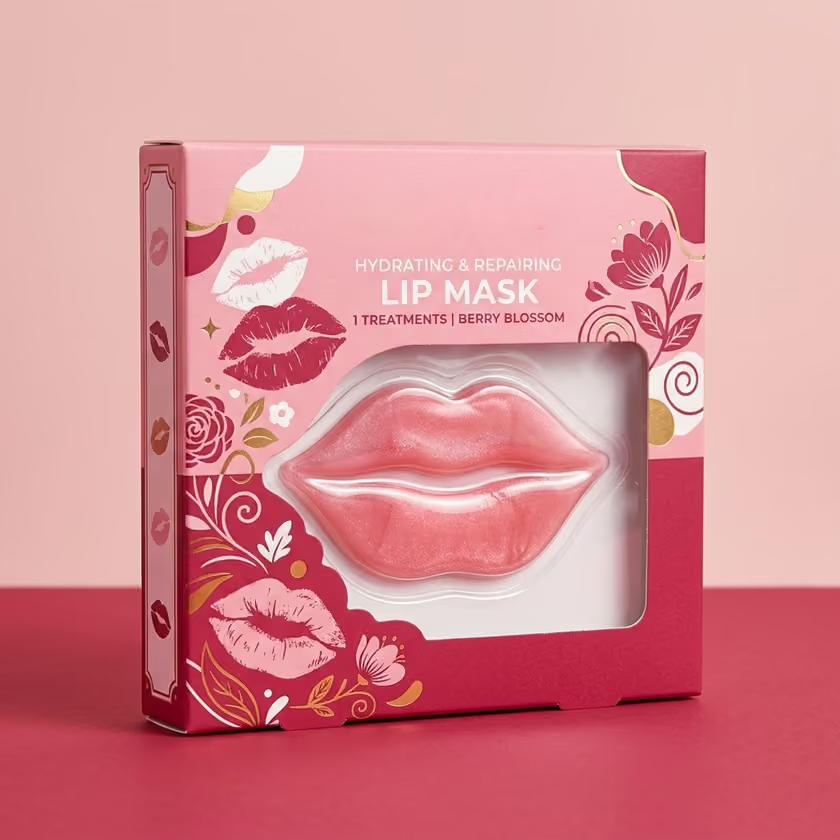


Lip Care packaging
Custom Lip Mask Boxes
Flat, wide cartons built for sealed hydrogel sachets, patch multipacks and jar-based sleeping masks rather than for upright tubes.
- Flat wide proportion suited to sachets and patch stacks
- Multipack counts from single doses to 20-patch boxes
- Window and insert options for jars and shaped patches
Price starts from $0.30 per piece for large-volume orders. Final pricing depends on size, material, printing, and quantity.
The starting figure applies to qualifying large-volume custom orders. It is not a fixed price for every quantity, and your written quote will state the actual unit price for your job.
Get a price for this box
Four fields. We reply with a written price for your quantity, or with the questions we need answered first.
A different shape from the rest of lip care
Almost everything else in lip packaging is a tall narrow box holding an upright tube. Lip masks are the exception. A hydrogel patch is flat, a sachet is flat, and a stack of twenty patches is a shallow rectangle. The carton follows the product, so lip mask boxes are wide and low rather than tall and slim.
That changes the design brief. A wide front panel gives you far more room for artwork, ingredient copy and usage instructions than a lipstick carton does, and it is the panel a shopper sees when the box lies in a tray or a basket rather than standing on a shelf.
The format also splits into three quite different products: single-dose sachets, multipack patch counts, and jar or tube-based sleeping masks. Each needs different internal support, and the third is closer to a skincare carton than to a lip product one.
Lip mask formats and what each carton needs
Single sealed sachet
One patch in a foil or clear sachet. A shallow carton with a snug cavity so the sachet cannot slide and crease.
Patch multipacks
Five, ten or twenty sachets stacked. Depth is set by the stack height, and a slight compression fit keeps the stack from shifting.
Loose patches in a tray
Unsachetted patches on a carrier film, held in a die-cut tray. Needs the most protection because the patch surface is exposed.
Jar sleeping masks
A small screw-top jar in an upright carton with a base collar. Closer to a skincare carton in proportion.
Tube sleeping masks
A squeeze tube with a nozzle applicator. Flatter than a gloss carton and usually lies down rather than standing.
Mailer and subscription boxes
A printed mailer that ships directly to the customer, with tissue, a card and the mask inside.
Protecting a hydrogel patch
A hydrogel patch is wet, soft and shaped. Its sachet does the barrier work, and the carton's job is to stop that sachet being bent, punctured or compressed. A creased sachet can crack its seal, and a patch that has dried at one edge is unusable even though the pack looks fine from outside.
The practical measures are a snug internal cavity so nothing slides, a board weight that resists being bent double in a shipping case, and for larger multipacks a base that will not open under the stack weight. Where patches are loose rather than sachetted, a die-cut tray holds each one flat and separated.
If the mask ships direct to consumers rather than to a retailer, the carton is doing shipping duty as well as presentation, and that usually means a heavier board or a corrugated mailer around it.
Board and material choices
Lip masks sit in a treatment category rather than a colour one, and the material choices tend to follow skincare conventions rather than cosmetic ones.
- SBS coated white board, 16pt to 24pt, for clean full-colour print and clinical clarity
- Uncoated and textured board where the range positions as natural or spa-oriented
- Kraft board for low-waste positioning, accepting muted colour reproduction
- E-flute corrugated for mailer boxes shipping direct to consumers
- Recycled greyback board where recycled content is a stated priority
- Clear film patches in PET or PLA where a window shows the patch shape
Uncoated board is worth considering here in a way it is not for gloss: a treatment product benefits from reading as calm rather than shiny, and uncoated stock does that without any finishing cost. The stock comparison sits on the board and material options.
Windows, patch shapes and shelf appeal
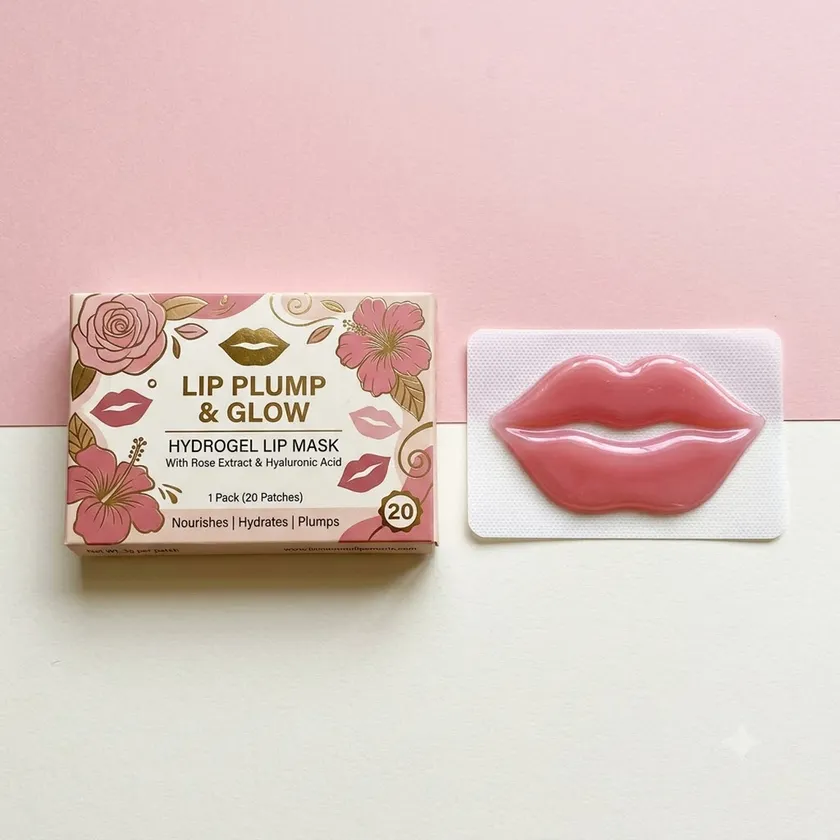
Lip masks have an unusual advantage: the product itself is a recognisable shape. A lip-shaped hydrogel patch behind a window explains the entire product in one glance, with no copy required. That is rare in packaging and worth using.
The most effective version is a window cut to roughly the patch outline, or a simple rectangle with the patch positioned centrally behind it. A clear film patch keeps dust out and stops the sachet moving in the aperture.
Where a window is not practical, printing the patch shape at actual size on the front panel achieves most of the same clarity. Photographic reproduction of a wet hydrogel patch is a genuine printing challenge though: the highlights blow out easily and the pink tones shift, so ask for a proof rather than approving on screen.
Printing, finishing and treatment-category cues
Treatment products are judged partly on how credible the pack looks, and legibility contributes to that more than decoration does. A clean full-colour print on white board with well-set type reads as trustworthy. Heavy foil and glitter can push a treatment product toward looking like a novelty, which is not always the intention.
Soft-touch lamination is the finish that suits this category most naturally, because it reads as considered rather than flashy. Matte lamination with a spot UV on the logo achieves something similar at a lower cost.
Where the mask is positioned as a gift or a self-care treat rather than a treatment, foil and pearlescent inks come back into play. The finishing options and how each behaves on different boards are set out on the coatings and finishing page.
Artwork, claims and usage copy
Lip mask packaging carries more copy than most lip products: ingredient declaration, net contents or patch count, directions for use, wear time and often a caution statement. The wide front and back panels give you room, but the allocation still needs planning before design starts.
Claims are the area to be careful with. Words describing appearance and moisture are cosmetic; wording that claims a physiological effect on the lip moves the product toward being regulated as a drug in the United States. We print exactly what you supply and do not review claim compliance, so have that copy checked before proof approval.
Supply artwork as PDF, AI or EPS at 300 dpi with 3 mm bleed and fonts outlined, built to the supplied die line, with window cut lines and any foil or spot UV areas on separate named layers. Details are on the artwork requirements page.
Quantity, patch counts and price
Patch count changes the carton, so a five-patch box and a twenty-patch box are separate die lines and separate quotes even though the artwork family is shared. If you plan to launch several counts, quote them together so the artwork and proofing work is done once.
Price starts from $0.30 per piece for large-volume orders. Final pricing depends on size, material, printing, and quantity. A single-dose carton is small and sits close to that entry figure at volume. A twenty-patch box with a window patch and a die-cut tray sits well above it, since it uses considerably more board and more production steps.
For subscription and direct-to-consumer programmes, tell us the monthly volume rather than the annual total. It affects whether we quote per release or as a scheduled call-off against one production run.
Getting lip mask cartons made
Send the sachet or jar details
Sachet dimensions and stack height for the count you want, or jar and tube dimensions for a sleeping mask.
Carton and insert proposal
We propose a carton proportion, board weight, base type and whether a tray or a window patch is needed.
Structural sample
A plain sample confirms the sachets or jar fit with the right compression and that the base holds the weight.
Proof and approval
A colour proof on the specified board, with the window cut in place, for written sign-off.
Production and dispatch
Printing, finishing, window patching, die-cutting, gluing and case packing, then delivery with tracking.
Quality control, delivery and disposal
The checks specific to this format are cavity fit and base strength. A cavity that is a millimetre generous lets a sachet stack shift and crease; a cavity that is a millimetre tight makes the box difficult to fill. Sample cartons are packed with actual product where you can supply it, because a fit that works on paper sometimes does not work with a slightly pillowed sachet.
Cartons ship flat and glued in counted cases. Where the pack is going to a filler or a co-packer, send their receiving requirements so the case count and labelling suit their intake process. Freight details sit on the shipping and delivery information.
On disposal, plain and varnished paperboard is widely recycled. A film window patch and any plastic lamination are separate materials the consumer has to deal with. For this category, where buyers often care about material choices, an uncoated board with a printed patch illustration rather than a window keeps the whole carton in one stream.
Custom Lip Mask Boxes specification
A summary of what can be specified on this product. Anything marked as quoted or made to order is confirmed in writing before production.
| Product type | Custom printed carton for lip masks, hydrogel patches and lip sleeping masks |
|---|---|
| Formats | Single sachet, patch multipacks, loose patch trays, jar and tube sleeping masks, mailer boxes |
| Proportion | Flat and wide for patches; upright with a base collar for jars and tubes |
| Multipack counts | Quoted to your sachet dimensions and stack height; die line differs per count |
| Materials | Coated white SBS 16–24pt, uncoated and textured board, kraft, E-flute corrugated, recycled greyback |
| Windows | Rectangular or patch-shaped die cut, with PET or PLA film patch |
| Inserts | Die-cut patch tray, base collar for jars, partition for mixed sets |
| Printing | Offset litho and digital; CMYK plus spot Pantone |
| Finishes | Soft-touch, matte and gloss lamination, spot UV, foil stamp, emboss |
| Copy allowance | Wide panels accommodate ingredient declaration, patch count, directions and cautions |
| Artwork format | PDF, AI, EPS at 300 dpi with 3 mm bleed and named finishing layers |
| Starting unit price | From $0.30 per piece on qualifying large-volume orders |
| Ordering | Quote based; each patch count is a separate die line |
Custom Lip Mask Boxes: common questions
Answers to the questions we are asked most often about this product. If yours is not here, put it in the enquiry form and we will answer it directly.
Why is a lip mask box a different shape from a lipstick box?
Because the product is flat rather than upright. A hydrogel patch and its sachet are shallow rectangles, and a stack of twenty is still shallow. The carton follows that geometry, which gives you a wide front panel instead of a narrow one and a lot more room for copy.
How snug should the carton be around the sachets?
Snug enough that the stack cannot shift, with a slight compression fit on a multipack. Too generous and the sachets slide and crease, which can crack a seal. Too tight and filling becomes slow. If you can send us actual sachets, we will fit the cavity around them rather than around their nominal dimensions.
Can I show the patch through a window?
Yes, and it is one of the strongest options available in lip packaging, because a lip-shaped patch explains the product without a single word. Cut the window to roughly the patch outline or use a simple rectangle with the patch centred behind it, and cover it with a clear film patch.
Does a window risk drying the patch out?
Not if the patch is in a sealed sachet, which does all the barrier work. A window over a sealed sachet is purely visual. Where patches are supplied loose on a carrier film with no individual seal, a window is not advisable because the carton itself is not a moisture barrier.
Do I need a separate box for each patch count?
Yes, because the cavity depth changes with the stack. A five-patch and a twenty-patch box are different die lines. If you plan several counts, quote them together so the artwork family and the proofing are handled once rather than three times.
What board weight suits a twenty-patch multipack?
Heavier than a single-dose carton. Twenty sachets have real weight and the box will be handled and stacked, so 20pt to 24pt with a snap-lock or auto-bottom base is a sensible baseline. A tuck flap base on a full multipack can open under the stack weight.
Can the carton double as a shipping box for direct-to-consumer orders?
A folding carton is secondary packaging, not a shipper, and sent loose in the post it will arrive crushed. For direct shipping, either place the carton inside a mailer with void fill, or specify a printed E-flute mailer box designed to take postal handling.
How do I fit the ingredient list, directions and cautions?
The wide panels on this format give you more room than most lip packaging, which is one of its advantages. Allocate the panels before designing: usually front for brand and patch count, back for ingredients, and a side panel for directions and wear time.
Will you check that my product claims are compliant?
No. We print the file you approve. Claim language matters in this category, because wording that claims a physiological effect on the lip can move a cosmetic toward being regulated as a drug in the United States. Have the copy reviewed before you approve the proof.
Is a photographic image of a wet hydrogel patch difficult to print?
Yes, more than most product photography. The highlights on a wet gel surface blow out easily and pink tones shift noticeably between substrates. Ask for a printed proof rather than approving on screen, and consider a spot colour for the patch tone if it is central to the design.
Which finish suits a treatment product?
Soft-touch or matte lamination reads as considered and credible, which is what a treatment claim needs. Heavy foil and glitter can make a treatment product look like a novelty. If the mask is positioned as a gift rather than a treatment, that changes and foil becomes appropriate.
Can you supply printed mailer boxes for a subscription programme?
Yes, in printed E-flute corrugated, along with printed tissue and insert cards if you want them. For subscription work, tell us the monthly volume rather than the annual total, since that determines whether we quote per release or as scheduled call-offs against one production run.
Other formats brands pair with this
Get a written price for custom lip mask boxes
Send your dimensions, quantity and artwork status. You will get a written quote with the price at your quantity and at the next volume break, plus anything we need clarified.
Price starts from $0.30 per piece for large-volume orders. Final pricing depends on size, material, printing, and quantity.