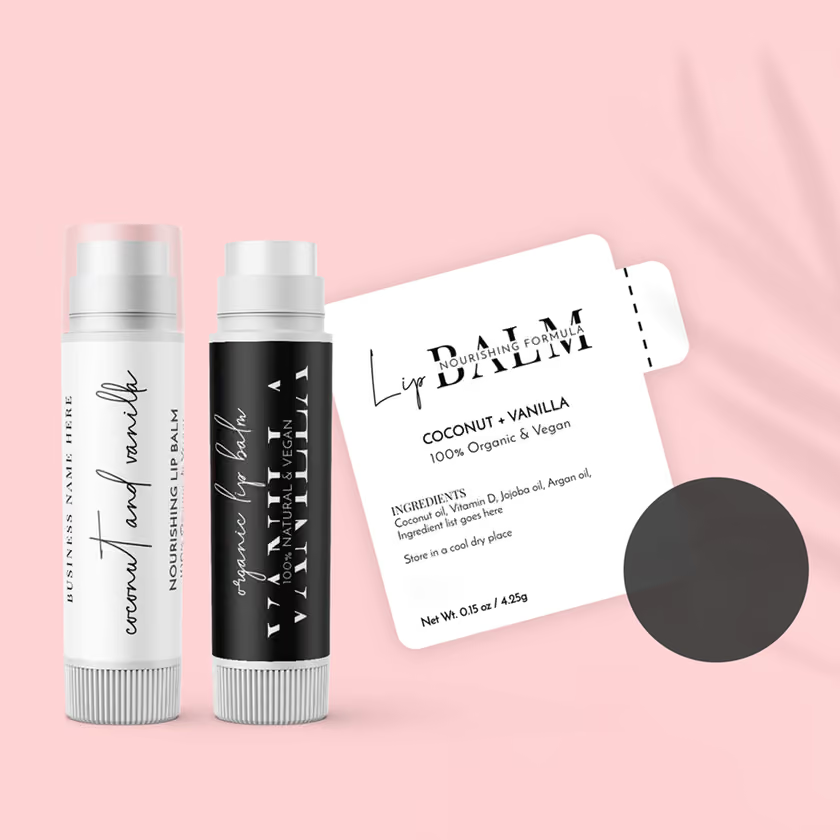


Lip Balm packaging
Custom Lip Balm Labels
Waterproof wrap labels die cut to your tube diameter, printed in full colour and supplied on sheets or on rolls for applicator use.
- Die cut to the exact wrap length of your tube
- Waterproof and oil-resistant synthetic stocks available
- Supplied on sheets for hand application or on rolls for a machine
Price starts from $0.30 per piece for large-volume orders. Final pricing depends on size, material, printing, and quantity.
The starting figure applies to qualifying large-volume custom orders. It is not a fixed price for every quantity, and your written quote will state the actual unit price for your job.
Price this specification
Four fields. We reply with a written price for your quantity, or with the questions we need answered first.
Labels for lip balm tubes, tins and jars
A lip balm label has a harder job than its size suggests. It wraps around a curved surface with almost no flat area, it sits against a product that is oily by definition, it lives in a pocket or a handbag where it is rubbed constantly, and it has to carry a legally required ingredient list in a space barely larger than a postage stamp.
That combination rules out ordinary paper sticker stock for most brands. Synthetic label materials handle the oil and the abrasion; uncoated paper is chosen when the matte, natural look outweighs durability. Both are printed here, and which one is right depends on where your product is sold and how it is carried.
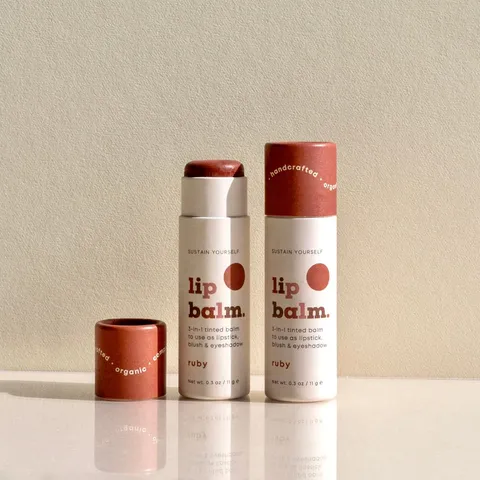
Labels are the fastest way to change a range. One blank tube stock plus five printed labels gives you five products without five sets of tooling, which is why brands running seasonal flavours usually label rather than print the container. If you would rather print the container itself, our directly printed paperboard balm tubes take artwork onto the body.
Label formats we produce
Full wrap tube labels
A rectangle that circles the tube body with a small overlap. The standard format for a 0.15 oz stick.
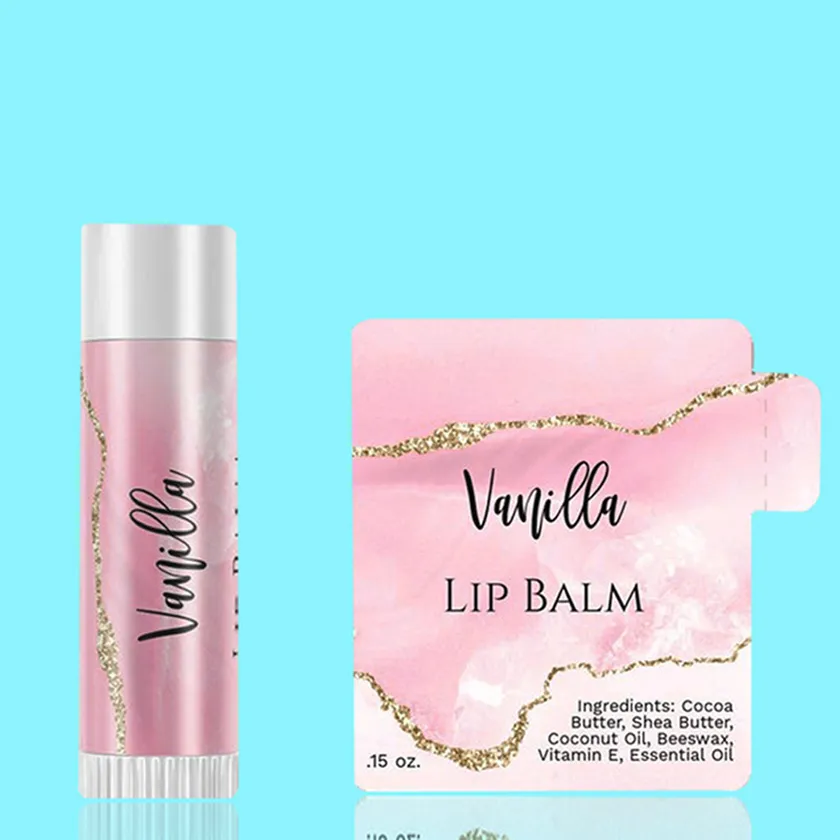
Die-cut wraps with a finger tab
A rounded or shaped edge that gives the user something to lift, and gives the label a less generic outline.
Cap and base seals
Small circular labels for the top of a cap or the underside of a tube, often carrying a batch code or a logo.
Tin and jar labels
Circular top labels and rectangular side wraps for screw-top tins, lip scrub jars and salve pots.
Tamper seal bands
A narrow strip printed with your brand that crosses the cap join and tears on first opening.
Multi-panel and peel-back labels
A hinged second layer that opens to reveal extra copy when the ingredient list will not fit on one face.
Label stocks compared
Stock choice is the decision that most affects how the label survives its first month in a customer pocket.
| Stock | Oil and water resistance | Look | Suits |
|---|---|---|---|
| White BOPP synthetic | High | Clean, slightly plastic, bright whites | Everyday retail balm, gym and outdoor ranges |
| Clear BOPP | High | No-label look on a coloured tube | Brands showing the container colour through |
| Metallised polyester | High | Silver or gold base under the ink | Limited editions and holiday sets |
| Uncoated kraft paper | Low without a varnish | Natural, matte, fibrous | Handmade and low-waste positioning |
| Coated white paper | Moderate with lamination | Sharp full-colour print, warm not stark | Boxed products where the tube is protected |
| Textured felt paper | Low | Tactile, premium, absorbs ink softly | Gift sets and boxed presentation only |
Where a label is expected to survive daily handling, add a laminate or a varnish over the print rather than relying on the ink alone.
Getting the label size right
Wrap length is circumference plus an overlap, not the width of the tube. A standard 0.15 oz oval stick usually needs a label somewhere near 2 by 1.5 inches, but oval and round tubes of the same nominal capacity have different circumferences, so measure rather than assume.
Overlap matters. Too little and the label lifts at the seam once oil gets under the edge; too much and the artwork doubles back over itself where the ingredient panel is. An eighth of an inch is a common starting point on a lip balm tube and we adjust it against your specific diameter.
Height should stop clear of the cap seat and the base flange, or the label will crease as the cap goes on. If you send us a sample tube, we measure the usable band ourselves and return a cutting template with the safe area marked.
Printing, finishing and adhesives
Digital label printing suits the quantities most lip balm brands actually order, handles variable data such as batch or shade names without a plate change, and lets you run several designs in one job. Flexo printing takes over at high volumes and holds solid spot colours with excellent consistency. Both support foil and spot varnish as finishing passes.
Over-print options are matte lamination, gloss lamination, matte or gloss varnish, spot UV, and cold or hot foil. On a product carried in a pocket, lamination earns its cost quickly; a bare digital print will scuff at the seam within weeks.
Adhesive selection is quietly important. A permanent acrylic adhesive is standard and holds well on plastic, paperboard and metal. Cold-applied products, tins that go in a fridge, or containers with a very low surface energy plastic can all need a specific adhesive, so tell us the container material in the enquiry. A summary of coatings and their behaviour appears on the page covering print finishes and coatings.
Artwork, legal copy and small type
Supply artwork as vector PDF, AI or EPS with fonts outlined, or as a 300 dpi PSD if the design is image-based. Build the file to the cutting template, allow bleed to the trim on all four sides, and keep critical copy at least 2 mm inside the cut line, because a rotary die on a small label has real tolerance.
The ingredient declaration is the hardest part of a lip balm label. US cosmetic labelling requires ingredients in descending order of predominance, the net quantity of contents, and the responsible party name and address. Setting that copy below about 5 pt on a curved surface makes it genuinely difficult to read, so brands often move it to a peel-back panel or to the outer carton instead.
We print the file you approve and do not audit its regulatory content. If your balm carries an SPF claim it is regulated as an over-the-counter drug in the United States and the panel requirements change, so have the layout reviewed before proof approval.
Sheets, rolls and how the labels get applied
Labels come on sheets or on rolls, and the choice follows how you apply them. Sheets suit hand application in small batches and are easier to store. Rolls are required for any semi-automatic or automatic applicator, and the roll has to be wound in the direction your machine expects, with a specified core diameter and unwind position.
If you are ordering rolls, send the applicator make and model with the enquiry. Getting the unwind direction wrong makes an entire roll unusable on the line even though the labels themselves are correct.
For hand application, a label with a die-cut tab is noticeably faster to place than a plain rectangle, and a slightly wider matrix around each label makes them easier to lift from the liner.
Quantity, artwork variants and price
Labels are the one product on this site where running many designs costs little more than running one, provided they share a size and a stock. A digital run of six scents at 2,000 each is priced close to a single design at 12,000, because the cutting die and the material are shared.
Price starts from $0.30 per piece for large-volume orders. Final pricing depends on size, material, printing, and quantity. Labels sit at the lower end of that range on plain paper stocks at volume, and above it on metallised material with foil and lamination.
One cutting die serves every reorder at that size, so keeping your range on a single label footprint pays back over time. Wholesale quantities and standing reorder schedules are quoted against a held specification.
Quality control and storage
Printed labels are checked for colour against the approved proof, for cut registration against the printed artwork, and for release from the liner. Registration is the failure most often noticed by customers, because a die that drifts by half a millimetre puts a visible white sliver along one edge of every label on the roll.
Store label stock flat, cool and out of sunlight, and use it within a reasonable period. Adhesive performance changes with age and with extremes of temperature, and a roll that has sat in a hot store room will not apply the way a fresh one does.
Paper-faced labels are compatible with paper recycling once separated from the container. Synthetic BOPP labels are not, and if the label stays on the tube it affects how the whole pack is disposed of. That is a genuine trade-off between durability and end-of-life, and worth weighing rather than assuming.
Ordering labels
Send the container details
Tube or tin dimensions, or a physical sample, plus the material the container is made from.
Choose stock and finish
We recommend a stock against how the product is sold and carried, and confirm whether lamination is worth adding.
Receive the cutting template
A flat template with the cut line, bleed and safe area for you or your designer to build to.
Proof and approve
A digital or printed proof confirms colour, cut position and that small type is legible at final size.
Print and dispatch
Labels are printed, finished, cut and supplied on sheets or on wound rolls to your specification.
Custom Lip Balm Labels specification
A summary of what can be specified on this product. Anything marked as quoted or made to order is confirmed in writing before production.
| Product type | Custom printed pressure-sensitive labels for lip care containers |
|---|---|
| Formats | Full wrap, die-cut wrap with tab, cap seal, tin top, tamper band, peel-back panel |
| Typical wrap size | Approximately 2 x 1.5 in for a standard 0.15 oz stick; cut to your tube |
| Face stocks | White BOPP, clear BOPP, metallised polyester, kraft paper, coated paper, textured felt |
| Printing | Digital and flexo; CMYK and spot Pantone |
| Finishing | Matte or gloss lamination, varnish, spot UV, hot and cold foil |
| Adhesive | Permanent acrylic as standard; alternatives specified against container material |
| Supply format | Sheets, or rolls wound to your applicator core size and unwind direction |
| Shapes | Rectangle, rounded corner, oval, circle and custom die-cut outlines |
| Artwork format | Vector PDF, AI, EPS with outlined fonts, or 300 dpi PSD |
| Variants | Multiple designs may share one die and one material at no proportional cost increase |
| Starting unit price | From $0.30 per piece on qualifying large-volume orders |
| Ordering | Quote based on size, stock, finish and quantity |
Custom Lip Balm Labels: common questions
Answers to the questions we are asked most often about this product. If yours is not here, put it in the enquiry form and we will answer it directly.
Will the label survive oil from the balm itself?
On a synthetic stock, yes. BOPP and polyester face materials resist oil and water and hold their print. Uncoated paper labels absorb oil at the edges over time and will darken and lift unless they are varnished or the tube is kept in an outer carton.
How do I measure my tube for a wrap label?
You need the circumference, not the diameter, plus the usable height between the cap seat and the base flange. Wrap a strip of paper around the tube, mark where it meets, and measure that length flat. Add about an eighth of an inch for the overlap, or send us a sample and we will do it.
Can I run several flavours in one label order?
Yes, and it is usually the most economical approach. If every design shares one size and one stock, they run together on the same die and the same material, so six designs at 2,000 each is priced close to one design at 12,000.
Should I order labels on sheets or on rolls?
Sheets if you apply by hand, rolls if you use any kind of applicator. Roll orders need the core diameter, the maximum outside diameter your machine takes, and the unwind direction. Send us the applicator model and we will set the winding to match it.
Can I get a no-label look on a coloured tube?
Yes, using a clear BOPP stock so the tube colour shows through the unprinted areas. Bear in mind that ink on clear film is translucent, so light colours and whites need a white underprint layer or they will disappear against a dark container.
How small can the ingredient text go?
Technically we can print very small type, but legibility on a curved surface falls off fast below around 5 pt, and on uncoated kraft it falls off sooner. If your ingredient list is long, a peel-back panel or moving the declaration to the outer box is a more practical answer than shrinking the type.
Do you supply a die line before I design?
Yes. Once the tube dimensions are confirmed we send a flat template with the cut line, the bleed area, the overlap zone and the safe area for critical copy. Building to that template avoids nearly every common label artwork problem.
Which adhesive should I choose for a metal tin?
A standard permanent acrylic adhesive bonds well to clean metal. Where tins are stored cold, or where the surface has a release coating from manufacturing, a different adhesive may be needed. Tell us the container material and the storage conditions and we will specify accordingly.
Can labels include a batch code or an expiry date?
Yes. Variable data can be printed digitally as part of the run, or you can leave a clear panel for your own inkjet or thermal coder to fill in during filling. The second option is more flexible if your batch numbers are not known at print time.
Are the labels waterproof?
Synthetic face stocks with a laminate or varnish over the print resist water and will not disintegrate. Paper stocks are not waterproof and should not be described as such. If the product will be used at a pool, on a hike or in a gym bag, choose a synthetic stock.
How long can I store unused labels?
Kept flat, cool and out of direct sun, label stock holds its adhesive properties for a long period. Heat is the main enemy. A roll stored near a warehouse ceiling in summer can develop adhesive ooze at the edges and become difficult to run through an applicator.
Can you match the label colour to my printed box?
We can get close, and we run them together where possible. Exact matching between a label film and a paperboard carton is not achievable because the two substrates absorb and reflect ink differently. Specifying a spot Pantone on both, rather than a CMYK build, narrows the gap considerably.
Commonly ordered alongside
Get a written price for custom lip balm labels
Send your dimensions, quantity and artwork status. You will get a written quote with the price at your quantity and at the next volume break, plus anything we need clarified.
Price starts from $0.30 per piece for large-volume orders. Final pricing depends on size, material, printing, and quantity.