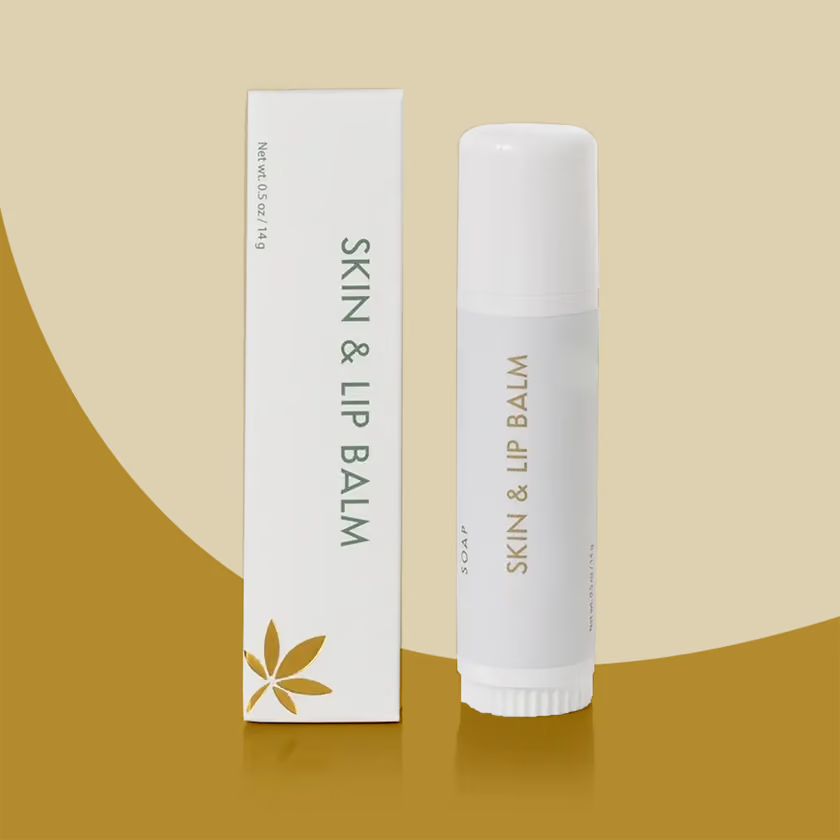


Lip Balm packaging
Custom Lip Balm Boxes
Single-tube cartons, multipacks and counter displays cut to the exact diameter and height of the lip balm tube you already fill.
- Sized to your filled tube, not to a fixed catalogue size
- Paperboard, kraft and coated stocks from lightweight to sturdy
- Single-tube, multipack and retail display formats
Price starts from $0.30 per piece for large-volume orders. Final pricing depends on size, material, printing, and quantity.
The starting figure applies to qualifying large-volume custom orders. It is not a fixed price for every quantity, and your written quote will state the actual unit price for your job.
Ask for a written price
Four fields. We reply with a written price for your quantity, or with the questions we need answered first.
What a custom lip balm box has to do
A lip balm tube is small, cylindrical and easy to lose on a shelf. The carton around it does three jobs at once: it stops the tube rolling, it gives you a flat printable surface for your brand and ingredient panel, and it holds the product upright wherever it is merchandised. Get the internal dimensions wrong by two millimetres and the tube rattles; get them tight and the carton splits at the glue seam during filling.
Every box we quote is cut from a fresh die line built around the tube you are actually filling. Send the outside diameter and the capped height, or post a sample to us, and the structural drawing is drawn to suit. That is the difference between a carton that closes cleanly on a hand-filling line and one that has to be forced.
Most lip balm brands start with a straight tuck end or reverse tuck end carton because both ship flat, assemble by hand in a few seconds and cost the least per unit. If you need the box to hang on a peg hook instead of sitting on a shelf, a lip balm box with a euro hang tab uses the same board and printing but adds a die-cut slot to the top panel.
Lip balm formats these boxes are built for
The same carton style covers a wide span of fill formats. What changes is the internal cavity and the board weight.
Standard twist-up sticks
The 0.15 oz oval and round sticks that dominate US lip care. Typical carton footprint sits close to 0.9 x 0.9 inches with a 3 inch height.
Jumbo and 0.5 oz tubes
Wider diameter tubes need a deeper cavity and usually move up a board weight so the walls stay square when the box is picked up.
Paperboard push-up tubes
Cardboard tubes have slightly more surface friction than plastic, so we allow a little extra clearance to keep insertion smooth.
Tins and pots
Screw-top tins and small jars sit in a shallow, wide carton. A platform insert stops the tin sliding when the box is shaken.
Multipacks and gift sets
Two, three, four and six-tube trays with a separate lid, or a single carton with a partition insert holding each tube apart.
Counter display units
A printed tray that ships flat, folds into an angled display and holds a dozen or more tubes at a checkout counter.
Sizing and internal dimensions
There is no fixed size list. Boxes are made to the measurements you supply, which is why the quote form asks for length, width and depth rather than offering a dropdown. Give us internal dimensions where you can, since that is what the tube has to fit into.
If you only have the tube itself, send its outside diameter and its total height with the cap on. We add the clearance, allow for board thickness on the closing flaps and return a die line for you to check before anything goes to print. For a single 0.15 oz stick, a finished carton usually lands somewhere between 0.8 and 1 inch square and 2.75 to 3.25 inches tall, but treat that as a starting point rather than a specification.
Multipack trays are quoted from the tube count and the layout you want, whether that is a straight row, a two-by-two block or a stepped arrangement. Tell us if the set has to fit inside an existing shipper carton and we will work backwards from that outer dimension.
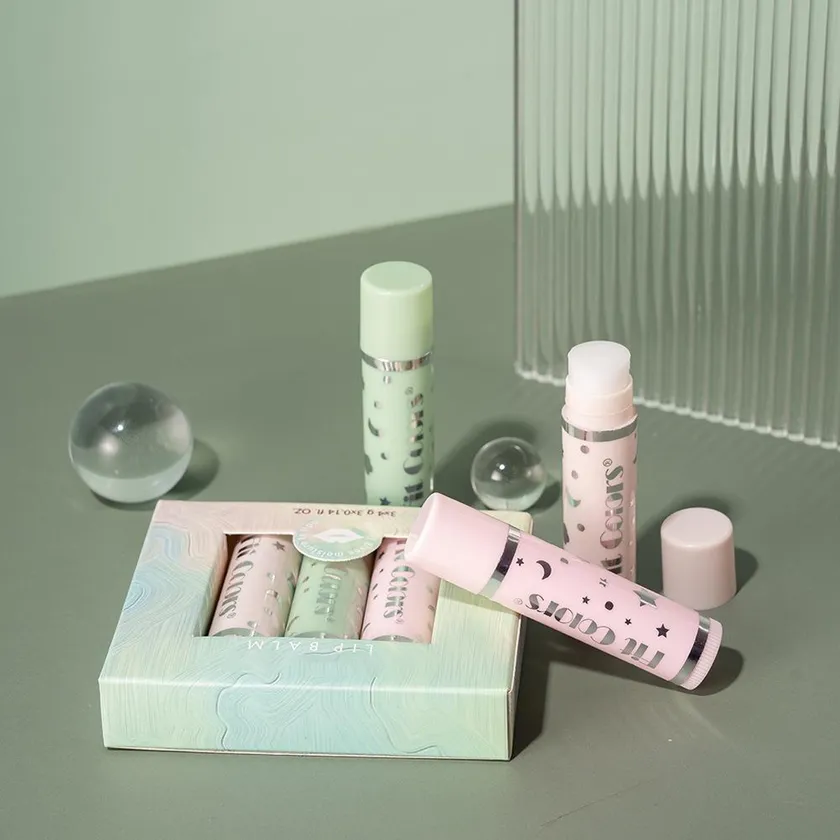
Materials and paper stock options
Board choice changes how the carton feels in the hand, how sharp the print looks and how well the box survives a shipping journey.
- SBS folding boxboard, 14pt to 24pt, with a bright white coated face for full-colour print
- Kraft board, 14pt to 24pt, uncoated with a natural brown surface and visible fibre
- Recycled greyback board where a recycled content claim matters more than a white reverse
- Coated one side board for cost-sensitive high-volume runs
- Corrugated E-flute for counter display units and heavier multipack trays
- Rigid greyboard wrapped in printed paper for premium gift sets
Lighter board keeps freight cost down on large runs, heavier board holds a crisper edge on a retail shelf. If you are weighing the trade-off, the comparison of packaging board weights and finishes sets out where each one performs.
Printing options for lip balm cartons
Which process suits you depends almost entirely on how many boxes you are ordering and how many colours the artwork uses.
| Process | Works well at | Strengths | Watch for |
|---|---|---|---|
| Digital | Under about 2,000 units | No plate charge, short setup, easy to run several shade variants in one order | Unit cost stays flat as quantity climbs, so it stops being economical on long runs |
| Offset litho | 2,000 units and up | Sharpest halftones and small type, lowest unit cost at volume, widest stock range | Plate setup is charged once per design, so small runs carry it disproportionately |
| Flexo | Very high volume on kraft | Efficient on uncoated board and simple spot-colour designs | Fine gradients and small reverse-out type lose definition |
| Spot Pantone | Any quantity | Holds one exact brand colour consistently across repeat orders | Photographic imagery still needs a four-colour build alongside it |
Colour behaves differently on kraft than on coated white board, so we send a print-ready proof for approval before the run starts.
Finishes and coatings
A lip balm box gets handled constantly at the shelf edge. Coating protects the print as much as it changes the look.
Matte lamination
A soft, non-reflective surface that reads as understated. Shows fingerprints on very dark solids, so pair it with a lighter palette or add spot gloss.
Gloss lamination
Deepens colour saturation and shrugs off scuffing. A practical choice for bright fruit or seasonal ranges.
Soft-touch lamination
A velvety film that changes how the carton feels before the buyer reads a word of it. Popular on higher-priced lip care.
Foil stamping
Metallic foil pressed into the board in gold, silver, rose gold or a coloured foil. Most effective on a logo or a thin frame rather than large solid areas.
Spot UV
Gloss varnish applied to selected artwork only, so a logo or a droplet illustration lifts off a matte background.
Embossing and debossing
Raises or recesses a shape into the board. It works on both coated and uncoated stock and needs no ink at all.
Structural styles and insert options
Straight tuck end is the default for a single tube: both flaps tuck from the same side, so the front panel stays uninterrupted for artwork. Reverse tuck end costs the same and closes from opposite sides, which some hand-filling lines prefer. Seal end cartons glue closed on the packing line and suit high-volume co-packers.
For anything heavier than a single stick, look at auto-bottom or snap-lock bases. Both lock into a flat base as the carton is opened, which means a four-tube multipack will not drop its contents when it is lifted from the bottom. The full range of closures is set out alongside their die lines on the guide to carton closures and base styles.
Inserts are worth the extra cost as soon as the box holds more than one item. A folded paperboard partition is the lightest option and keeps tubes from knocking together. Die-cut card platforms hold a tin or a jar in a fixed position. Moulded pulp trays suit gift sets where the presentation on opening matters. Foam inserts are available but are rarely the right answer for a product this light.
Branding and artwork requirements
Supply artwork as a print-ready PDF, AI or EPS file at 300 dpi with fonts outlined and images in CMYK. Add 3 mm of bleed on every edge and keep live text at least 4 mm inside the trim line, because a folding carton is cut and creased in one pass and small drifts are normal.
Cosmetic packaging also has to carry regulated information. In the United States that means an ingredient declaration in descending order, net contents, and the name and place of business of the responsible party. If your balm carries an SPF claim, the drug facts panel has its own layout rules. We print what you supply and do not review compliance on your behalf, so have those panels checked before the file is approved.
If you do not have print-ready files yet, send a sketch, a competitor reference or a rough layout with your quote request. Our studio can build the die line and lay your elements onto it. Detailed file preparation notes, including how we handle spot colours and foil layers, are set out in the artwork preparation notes for folding cartons.
Quantity, wholesale ordering and unit price
Lip balm cartons are quoted per project rather than from a price list, because a 500-unit digital run and a 100,000-unit litho run are different pieces of work. Price starts from $0.30 per piece for large-volume orders. Final pricing depends on size, material, printing, and quantity. That figure is a starting unit price for qualifying high-volume custom orders, not a fixed rate for every quantity.
The largest single lever on unit price is quantity, because setup, plates and die charges are spread across the run. Moving from 1,000 to 10,000 units typically cuts the per-box cost substantially even before any specification changes. After quantity, the biggest factors are board weight, the number of print colours, and whether the job carries foil, spot UV or an insert.
Wholesale and private label orders are welcome, including repeat scheduled releases against a single approved die line. Once a die is cut and a proof is signed off, reorders skip most of the setup work. Tell us in the quote request if you expect to reorder on a cycle so the tooling is quoted with that in mind.
How an order runs
Five stages from first message to delivered pallet.
Send your specification
Dimensions or a sample tube, quantity, board preference and any finishing you have in mind. A rough brief is enough to start.
Receive a written quote
We come back with pricing at your quantity, plus alternatives at higher volumes so you can see where the breakpoints sit.
Approve the die line and proof
A structural drawing and a printed or digital colour proof go out for written approval. Nothing runs until you sign it off.
Production
Printing, finishing, die-cutting, gluing and quality inspection. Boxes leave the line flat and bundled.
Dispatch
Cartons are packed on pallets or in shipping cases and released with tracking to your nominated address.
Quality control and material responsibility
Every run is checked at three points: a press-side colour check against the approved proof, a dimensional check on the first die-cut sheets, and a glue and fold test on finished cartons pulled from the line. Because lip balm boxes are small, a die that drifts shows up quickly in the tuck fit, which is why the fold test matters more here than on a large carton.
On the material side, folding boxboard and kraft board are both widely recycled through standard US kerbside paper streams once any laminate film is accounted for. If recyclability is a priority, an uncoated or varnish-only finish keeps the carton in a single material stream, and soy or vegetable-based inks are available on request. We will confirm what a specific stock carries in the way of certification at quoting stage rather than making a general claim here.
Turnaround and delivery
Production time depends on the print process, the finishing and how quickly proofs come back approved. A straightforward digitally printed carton moves faster than a litho run with foil and a custom insert. We confirm a production window in writing with your quote and update it if the specification changes.
Orders ship to addresses across the United States, and rush schedules can often be arranged when a launch date is fixed. Current lead-time bands and the information we need in order to commit to a date are set out on the production and lead time page.
Custom Lip Balm Boxes specification
A summary of what can be specified on this product. Anything marked as quoted or made to order is confirmed in writing before production.
| Product type | Custom printed folding carton for lip balm |
|---|---|
| Sizing | Made to your dimensions or to a supplied sample tube |
| Common single-tube footprint | Approximately 0.8–1 in square, 2.75–3.25 in tall |
| Materials | SBS folding boxboard, kraft board, recycled board, E-flute, rigid greyboard |
| Board weights | 14pt to 24pt paperboard; heavier substrates on request |
| Printing | Digital, offset litho, flexo; CMYK and spot Pantone |
| Finishes | Matte, gloss and soft-touch lamination, spot UV, foil stamp, emboss, deboss |
| Structural styles | Straight tuck end, reverse tuck end, seal end, auto-bottom, snap-lock, tray and lid |
| Inserts | Paperboard partitions, die-cut platforms, moulded pulp trays |
| Windows | Die-cut window with optional clear film patch |
| Artwork formats | PDF, AI, EPS, PSD at 300 dpi with 3 mm bleed |
| Starting unit price | From $0.30 per piece on qualifying large-volume orders |
| Ordering | Quote based; no fixed catalogue pricing |
Custom Lip Balm Boxes: common questions
Answers to the questions we are asked most often about this product. If yours is not here, put it in the enquiry form and we will answer it directly.
What dimensions should I give you for a lip balm box?
Send internal length, width and depth in inches or millimetres if you have them. If not, measure the outside diameter of the filled tube and its height with the cap on, and tell us which of the two you measured. We add the running clearance and the allowance for board thickness ourselves and return a die line for you to check.
Can you make a box for a tube I already buy from another supplier?
Yes. That is the usual situation. Post us a sample of the filled tube, or send the supplier drawing if you have one, and the carton is built around it. Sending a physical sample is the most reliable route because it captures cap tolerances that a drawing sometimes omits.
Is there a minimum order quantity?
Minimums depend on the print process and the finishing you choose. Digital printing supports genuinely short runs, while offset litho and foil work carry setup costs that need a larger quantity to make sense. Tell us the quantity you actually want and we will quote it rather than pushing you to a fixed minimum.
How does the $0.30 starting price relate to my order?
Price starts from $0.30 per piece for large-volume orders. Final pricing depends on size, material, printing, and quantity. It applies to simple, high-volume specifications. A short run with foil stamping and a die-cut insert sits well above it, and your written quote will always state the actual figure for your job.
Which board weight suits a single lip balm stick?
For one 0.15 oz stick, 14pt to 18pt paperboard is usually enough to hold its shape through retail handling. Move to 20pt or 24pt if the carton is taller than about three inches, holds more than one tube, or will be shipped loose to consumers rather than inside a shipper case.
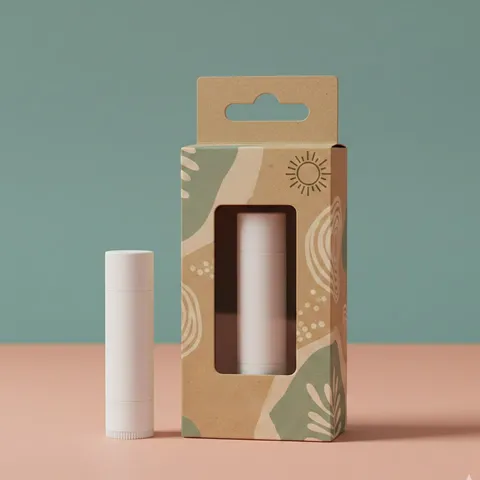
Can I have a window so the tube colour shows through?
Yes. A window is die-cut into the panel you choose and can be left open or covered with a clear film patch. A film patch keeps dust out and stiffens the panel slightly, which is worth having if the window is large. Windows do add a step to production, so allow for it in your schedule.
Do you print the ingredient and net weight panel for me?
We print exactly what your artwork contains. Writing the ingredient declaration, net contents statement and responsible party details is your responsibility, and if the balm carries an SPF claim the drug facts panel has its own layout rules. Have that copy reviewed before you approve the proof.
Can I order a multipack box and a single box together?
Yes. They are separate die lines and separate print jobs, but they can run in the same order and ship together. Running them at the same time also keeps the colour consistent between the two, which is harder to guarantee if you order them months apart.
Will kraft board print my brand colours accurately?
Kraft is an uncoated brown substrate, so ink sits into the fibre and colours shift warmer and darker than they appear on white board. Pale tints and bright whites do not reproduce at all without a white underprint. If exact colour matching matters, ask for a proof on the actual kraft stock before you commit.
Can I get a sample before ordering a full run?
A plain unprinted die-cut sample confirms that the carton fits your tube, and a printed sample confirms colour and finish. Which of the two is appropriate depends on what you are checking. Request one through the sample kit page and tell us what you need to verify.
How should the boxes be packed for shipping to my filler?
Cartons are supplied flat, glued along one seam, bundled in counted stacks and cased or palletised. Tell us the case count your filling operation prefers and we will pack to it. If the boxes are going straight to a third-party co-packer, send their receiving requirements with the order.
Can I reorder the same box later without redoing the setup?
Yes. Once a die line is cut and a proof is approved, we hold both against your account. Repeat orders skip die and proofing charges, and the reorder is quoted on the print and material cost at whatever quantity you need next time.
Often specified together
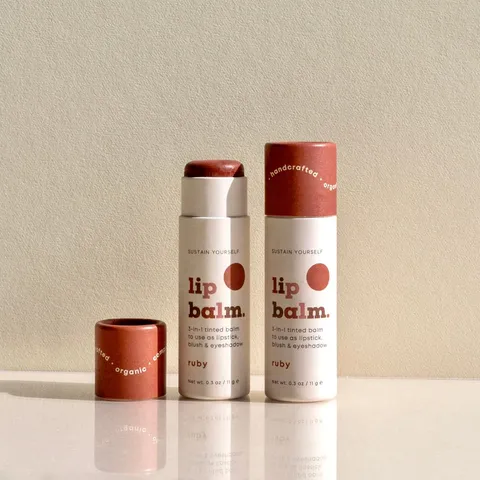
Get a written price for custom lip balm boxes
Send your dimensions, quantity and artwork status. You will get a written quote with the price at your quantity and at the next volume break, plus anything we need clarified.
Price starts from $0.30 per piece for large-volume orders. Final pricing depends on size, material, printing, and quantity.