A market built on independent launches
Atlanta supports an unusually large number of independent lip gloss and colour brands, many of them founded and run by a single person, selling primarily online and through pop-up and event retail.
The packaging requirements that follow are specific. Quantities are modest, often a few hundred to a few thousand per shade. Launch cycles are short, sometimes tied to a content schedule rather than a retail calendar. And the pack has to photograph well, because most of the selling happens on a screen before anything reaches a customer.
That combination favours digital printing, one guide to packaging die lines across a range, and finishes that read on camera rather than only in the hand.
Packaging that photographs
Packaging for a brand that sells mostly through images has a requirement most retail packaging does not: it has to survive being photographed under uncontrolled lighting by someone with a phone.
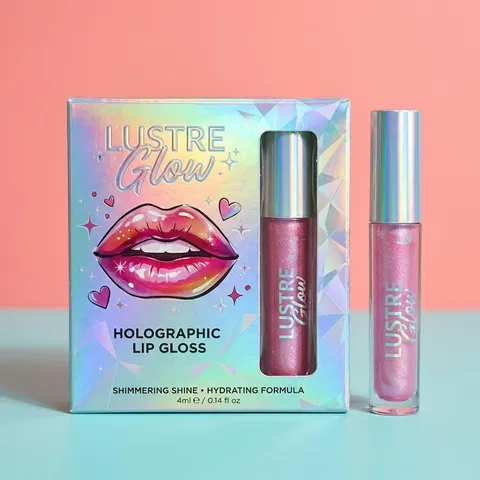
Some finishes help. Holographic and metallised board shifts colour as the camera moves, which reads as movement in video. Spot UV finish options over matte creates contrast that a camera picks up more reliably than a subtle emboss does. Foil catches light in a way that photographs as genuinely metallic.
Some finishes work against you. Soft-touch lamination feels expensive and photographs as flat grey. Very fine embossing disappears entirely at phone resolution. And a high-gloss laminate reflects the ring light straight back into the lens. Our iridescent gloss carton page covers what actually changes under light.
Making short runs work
Six decisions that keep a small-quantity launch affordable.
- Digital printing, which carries no plate charge per design and suits a wide shallow shade range
- One die line across every shade, so the tooling is paid once rather than per variant
- A shared board and finish, so the whole range can be produced in one window
- Spot colour only where it earns it, usually the shade swatch and nothing else
- Holographic foil on a logo rather than full holographic board, which is a material premium on every unit
- A reorder plan, since a second run against held tooling costs far less than the first
The last point is the one most first-time brands miss. Telling a supplier at the first quote that you expect to reorder changes how the tooling is quoted.
Ordering and delivery in Georgia
Packaging is made to order and shipped to Georgia addresses through a nationwide service. There is no Georgia facility, no local stock and no collection point.
For brands shipping from home or a small studio rather than a commercial address, say so at quoting stage. Residential delivery changes the service level and the cost, and a pallet arriving at a house without a liftgate arranged is a problem that is easier to prevent than to fix.
Where a launch date is fixed by a campaign rather than by a retail reset, tell us the date early. The usual route to a tight schedule is choosing a print process and finishing that suit the timeline, not expediting an elaborate specification.
Questions that come up on Georgia orders
What quantities do you quote for an independent brand?
Whatever you actually want. Digital printing carries no plate charge per design, so a few hundred per shade across several shades is a normal order. Tell us the total and the per-shade split, because the split decides which press we quote.
Which finishes photograph most reliably?
Holographic and metallised board, because they shift under movement and read well in video. Spot UV over matte gives contrast a phone camera picks up. Foil photographs as genuinely metallic in a way printed metallic ink does not.
Which finishes photograph badly?
Soft-touch lamination, which feels expensive and photographs as flat grey. Very fine embossing, which disappears at phone resolution. And high-gloss laminate, which reflects a ring light straight back into the lens.
Is full holographic board affordable at small quantities?
It is a material premium on every unit that does not fall away with volume. Holographic foil on a logo over a matte laminated standard board delivers most of the shelf and camera impact at a much lower unit cost, and is usually the better call at short runs.
Can I launch several shades without paying setup on each?
Yes, if they share one die line, one board and one finish, with only the printed panel changing. On digital there is no per-design plate charge at all, so the tooling is paid once for the whole range.
Can you ship to a residential address?
Yes, but tell us at quoting stage. Residential delivery changes the service level and the cost, and a pallet arriving at a house without a liftgate arranged is a problem that is much easier to prevent than to resolve.
How fast can you turn a launch around?
We confirm a production window in writing with the quote rather than publishing a figure, because it depends on the specification and on how quickly proofs come back. On a tight date, simplifying the finishing usually saves more time than expediting does.
Is there anywhere in Georgia I can collect an order from?
No, there is no collection point. Orders are made to order and delivered to the Georgia address on your quote, so nothing is ever waiting to be picked up.
Lip Boxes has no office, plant, warehouse or held stock in Georgia. Packaging is made to order and shipped to Georgia addresses through a nationwide carrier service. Delivery cost and lead time are quoted per order.