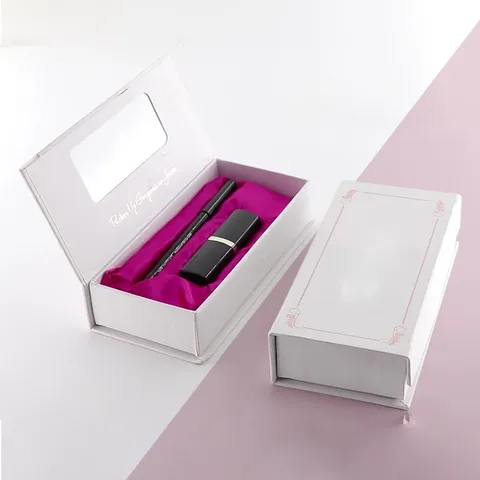
There is no standard lipstick box size
Lipstick cases vary far more than lip balm tubes. A slim aluminium bullet, a weighted magnetic case and a square resin barrel can all hold 3.5 g of product and need three different cartons. Any supplier quoting from a standard size is guessing.
For orientation rather than specification: a single-bullet carton commonly falls between 0.9 and 1.2 inches square and 3 to 3.5 inches tall. Treat that as the range you will land in, not the size to order.
How to measure a bullet case
Three measurements, taken in the right places, prevent nearly every fit problem.
- Width at the widest point with the cap fitted. On many cases that widest point is the cap itself, but on tapered cases it is lower down.
- Depth at the same widest point, since square and oval cases differ on the two axes.
- Total height with the cap fully seated, not the height of the barrel alone.
Why a physical sample beats a drawing
Supplier drawings frequently omit real-world tolerances. Magnetic cases are the worst offenders: the cap can sit a fraction proud at the join, and a carton built to the nominal drawing will bind on every unit. Lacquered cases can also be marginally larger than their bare-metal specification because of the coating.
Posting a filled sample case to your packaging supplier costs almost nothing and removes the whole category of risk. If you cannot, send the drawing and say explicitly that it is a drawing rather than a measured sample, so extra clearance can be allowed.
Choosing a structure
Once dimensions are settled, structure is mostly a merchandising and packing decision rather than a visual one.
| Structure | Suits | Notes |
|---|---|---|
| Straight tuck end | Shelf display and boxed e-commerce | Front panel stays uninterrupted; both flaps tuck the same way |
| Reverse tuck end | Hand packing lines | Same cost; flaps close from opposite ends |
| Seal end | Automated co-packing | Glued shut on the line; needs a sealer |
| Auto-bottom | Duos, trios and heavier packs | Base locks flat as the carton opens |
| Sleeve and tray | Higher price points | Two pieces, more presence, more cost |
| Hang tab carton | Peg and clip strip retail | Load concentrates at the slot; needs reinforcement above single-unit weight |
| Rigid magnetic box | Gift sets and limited editions | Ships assembled, not flat; hand assembled |
When to add an insert
A lipstick case is dense for its size, particularly a metal-weighted one. In a loose carton it slides under its own inertia, and repeated movement in a shipping case marks both the case finish and the inside of the box.
For anything above an entry price point, a folded paperboard collar at the base is worth the small cost. For duos and trios a partition is not optional: lacquered and foiled cases scratch each other, and a set that arrives marked defeats the point of the pack.
Where the opening moment is part of the product, a fitted tray that presents the bullet at an angle belongs with a rigid box built around a fitted tray rather than with a folding carton.
Plan the panels before you design
A slim lipstick carton has less usable surface than most brands expect. Shade name, shade number, finish descriptor, net weight, ingredient declaration, responsible party details and a barcode all have to fit, and the barcode needs about 1.5 inches of clear width on a flat panel away from creases.
Allocate the panels first, then design into them. Where the ingredient list will not fit legibly, a small folded leaflet inside the carton is a normal and inexpensive answer.